


Make me a melody Old One
Make me sure
Remind me I’m the animal
Who dances for the Dawn
– ‘Old One’, Finnegan Tui
Climate change, biodiversity loss, and environmental degradation threaten to silence the Earth’s rich chorus of life. Yet even as glaciers melt, forests fall, and species vanish, nature remains resilient, adaptive, tenacious. The return of spring in the Northern Hemisphere once again cloaks the land in green, and the songs of chiffchaffs, thrushes, and redstarts signal renewal and hope. Inspired by this enduring vitality, I’ve been reflecting on my experiences reciting poetry and singing in nature to counter stifling and subduing forces.
This reflection feels especially timely as it marks five years since the launch of Earth Tongues. The collective takes its name after a family of fungi that we imagine as rising up in protest against planetary harms caused by human greed and ignorance.
One evening while camping in a southern wood, I chanced upon a red deer. Such sightings are common for one who walks often, but this time I felt compelled, almost instinctively, to make the meeting more intentional. Just before the cervid darted away, I raised my hand and called to him, telling him to go in peace. As my voice lingered and the deer disappeared, I sensed I had touched him more deeply than if I had remained silent. This being’s inherent personhood was amplified by my having spoken out loud — one animal to another. David Abram recounts a similar experience, in which his voice calms a mother moose:
The surprise, perhaps even reverence, which caused Abram to sing bridged the gap we often hold open between human and animal.
Our voices are extensions of our inescapable animality, tethering us to the primal rhythms of our being. Yet it is commonly held that humans stand apart from nature, which is rendered an insignificant backdrop upon which we impose cultural meaning. Moreover, anthropocentrists often elevate the creative endeavours of humans, assigning culture to Homo sapiens alone. Roger Scruton, for example, claims that ‘although we can hear music in the songs of birds, whales and bonobos, they themselves are deaf to it. Nothing is to be learned about music and its meaning […] from studying the sounds made by animals’.1 But as, Patrick Curry points out, this stance privileges human consciousness in the same extreme way that some scientists overemphasize base evolutionary instincts and processes, which similarly devalue nonhuman voices.2 Who has heard a bird or a whale and not thought that their songs held a certain joyous gratuitousness and autonomy?
How isolating it is to view nonhuman beings as mindless machines — like the automaton birds chirping upon a gilded tree near Emperor Theophilos’s throne — with nothing to offer, nothing to teach. On the contrary, in ancient and traditional worldviews, singing and speaking are considered a way of engaging with a world already rich in meaning, facilitating a ‘poetics of dwelling’, as Tim Ingold posited.3 Ingold describes the indigenous view of singing as another way of knowing the Earth, akin to tracking or foraging, since ‘in hunting and gathering, as in singing and storytelling, the world “opens out” to people. Hunter-gatherers, in their practices, do not seek to transform the world; they seek revelation’.4 Similarly, singing offers guidance and wisdom, which are sought directly from the source, embodying a continuous, engaged, and bodily involvement with the world.
Across time and cultures, the voice has linked people to nature. Siberian shamans sang to summon animal spirits, while Indigenous Australians used songlines to map their homeland. The Orphic Hymns of ancient Greece honoured Gaia, reflecting a belief in the voice’s connection to life itself. Celtic bardic traditions, such as those embodied by Ossian and Taliesin, blended legend and landscape into collective memory. In the Early Middle Ages, Norse and Anglo-Saxon poets echoed nature’s rhythms and power. Later, troubadours such as Bernart de Ventadorn praised the natural world in love-filled verse, while St Francis of Assisi composed hymns celebrating creation’s beauty. By the Romantic period, poets like Blake and Coleridge heard a spiritual voice in nature calling out to humanity.
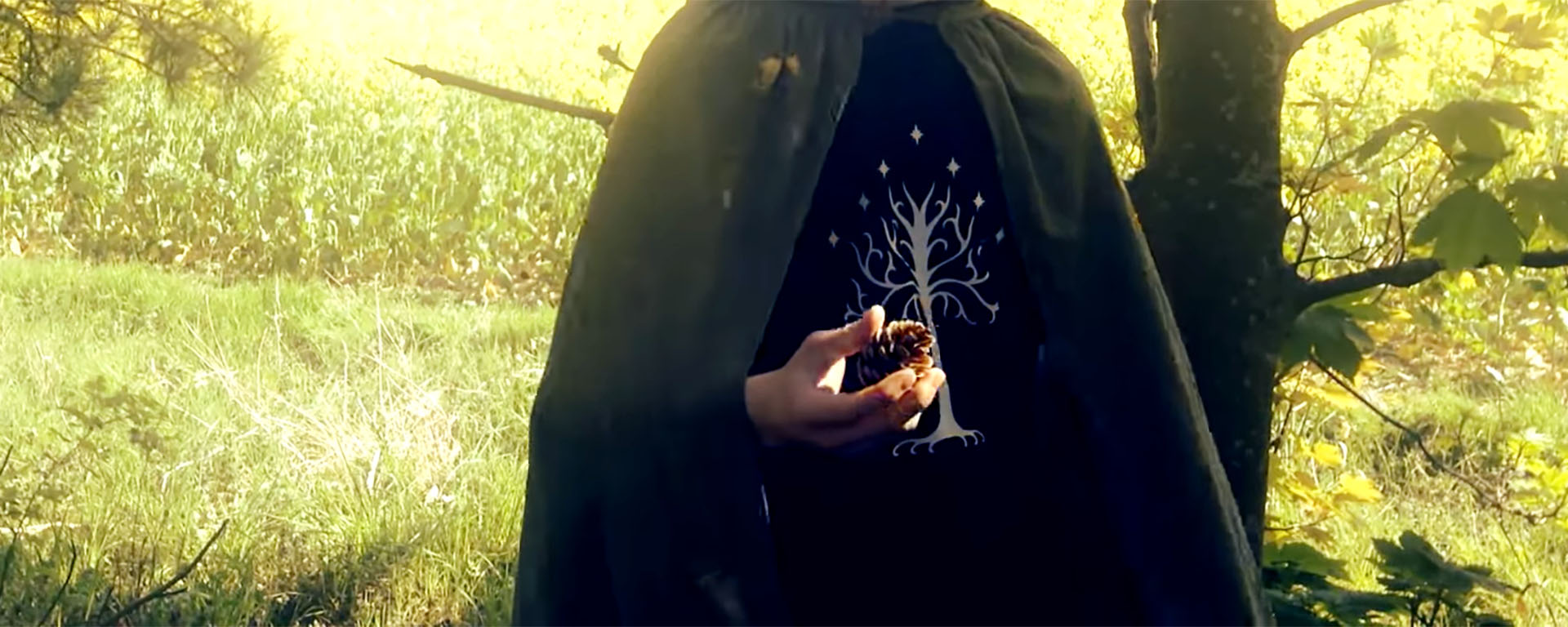
While I am not a trained singer or musician, I try to keep these traditions alive in my own small way by regularly voicing my appreciation of nature. This practice has developed over time, finding its fullest expression in Tolkien Memorised, a project I’ve run with my twin, Ryan, for several years.
We chose Tolkien because nature is an integral part of all his tales, and his songs and poems reflect that connection by recalling history, honouring places, or summoning something greater than oneself, revealing the interwoven tapestry of life, land, and lore. For instance, the songs of the Hobbits bring warmth, humour, and a love of everyday rural life into The Lord of the Rings, anchoring the narrative in humble pleasures. In contrast, the Elves sing of stars, rivers, and ancient forests, their identity ingrained in the beauty and sorrow of a fading world.
I still remember our first recording: a recitation of ‘Namárië’, spoken by Lady Galadriel. There was a feeling of trepidation about doing justice not only to her soulful expression of loss and the passage of time in Middle-Earth but also to our own perishing ecosphere.
To gather myself, I let the stillness of the wood envelop me — and listened. Listening is an essential foundation for performance that allows us to commune with other forms of existence and reawaken our inner animal. For, as Abram suggests, ‘Our bodies have formed themselves in delicate reciprocity with the manifold textures, sounds, and shapes of an animate earth — […] our ears are attuned by their very structure to the howling of wolves and the honking of geese’.5 Listening thus, I became aware of sounds — birdsong, wind, rustling leaves — imbued with their own sense of movement and life. This type of attentive listening accommodates a more relational mode of being.
Receptivity and relationality can help foster enchanting experiences, especially of music or sound perception generally. According to Curry, ‘Gaps are a prerequisite for relations, and thence metaphoric truth, in enchantment’; thus, ‘there can be no enchantment in music without gaps between the tones, without pauses for the perceptual items to be […] in relation to each other’.6 But intervals can be either too long or non-existent, such that complete silence and a wall of noise are often equally disenchanting. Following this same principle, Curry contends that instead of a vibrant hum of life suffused with texture and dynamism, we are increasingly faced with either the eerie hush of a lifeless world or a human cacophony.7 In both cases, the disruption of the delicate balance that allows for enchantment through sound is due to our unrelenting and often destructive activities.
Anthropogenic clamour from planes, traffic, construction, war and overpopulation is irreparably altering species’ manifold lifeways across terrestrial and aquatic ecosystems.8 It is also deteriorating our own mental wellbeing by further detaching us from nature’s rhythms and cycles.9 As such, we cannot easily find enchantment in particular places and moments that hold significant meaning for us. Curry puts it beautifully:
Enchantment is personal. This is reflected in the word itself, which comes from the Latin verb cantare, to sing, plus the preposition en, in, which became the Old French enchantement, which then passed into Middle English. It thus means the experience of being, or finding oneself, in song. Whether it is a song that one hears or that one is singing, one finds oneself both listening to it and experiencing it from the inside. The song can be any narrative, whether heard, read, seen or imagined. But you have to be there, participating.10
Notably, Samwise Gamgee experiences one such rhapsodic moment in Lothlorien, describing the woodland realm as like being ‘inside a song’.11 It’s a rare glimpse of presence, so often absent in modern life.
Overburdened and overwhelmed by human-centred desires and designs, we fail to recognise that we are but one part of a wondrous, mysterious tale billions of years in the making. Tolkien well understood this. For in his epic The Silmarillion, music births the universe itself. This foundational act of creation sets the tone and provides the impetus for the continuing narrative of Middle-Earth, where every character, whether they know it or not, is part of an ongoing story.
Among the many poems we’ve recited, ‘The Song of Eärendil’ stands out, both for its literary depth and for how it connects us to the Earth as storied and sacred. Ryan spent weeks learning it by heart, drawn in by its complexity and the challenge it posed.12 The poem tells of the adventures of Eärendil, a great mariner in Tolkien’s legendarium, who sails into the heavens with a Silmaril, becoming a star — a beacon of hope in a dark world. This poem draws us into a lineage of tales, the same one in which Sam once again finds himself:
But that’s a long tale, of course, and goes on past the happiness and into grief and beyond it – and the Silmaril went on and came to Eärendil. And why, sir, I never thought of that before! We’ve got – you’ve got some of the light of it in that star-glass that the Lady gave you! Why, to think of it, we’re in the same tale still! It’s going on. Don’t the great tales never end? 13
Performing this poem lets us inhabit a space where language, memory, and nature merge, leading us back to the personal, to places and verses that have shaped our own story.
One of my favourite poems in this vein is ‘Galadriel’s Messages’. I first read it when my love of nature was budding, and it still moves me, especially the warning to Legolas:
Legolas Greenleaf long under tree
In joy thou hast lived. Beware of the Sea!
If thou hearest the cry of the gull on the shore,
Thy heart shall then rest in the forest no more.14
These lines speak to the kind of profound attachment to nature that we ourselves hope to maintain well into old age. Over time, their meaning has evolved, evoking the tension of living in two places at once. Like Legolas, we call across the distance, from the woods of the Chilterns to Scotland’s east coast, where we grew up. Such recitations collapse time and space, weaving past and present into a single, resonant dialogue.
Clearly, Tolkien was a fantasist of place and longing par excellence. In ‘Song of Lebennin’, sung by Legolas during war and strife, the words provide a refuge, a peaceful recollection of natural abundance. In these brief lines, we are privy to a world still green and singing. In this way, the poem mirrors our desire to respond not just with lament but with celebration and care. This impulse towards reverence and remembrance, kindled by Tolkien’s verses, finds further expression in our own attempts to give thanks.
Many of these performances are ultimately expressions of gratitude — to nature, for the gift of living in what we consider one of the world’s most idyllic places, and to Tolkien, whose work continues to inspire amid brashness, nihilism and destruction.
Middle-Earth, with its deep-rooted sense of place and history, as well as its profound understanding of how nature and creativity are linked, has long shaped the way Ryan and I relate to the world. Since childhood, we’ve written stories. Our most significant creation is a shared fantasy narrative, which began as a single name spawned in our minds more than twenty years ago as we sat by the sea in some far country, listening to the waves and awed by an endless horizon. Whenever we return to beloved places in Scotland, we recite passages from this narrative as a way of honouring an ever-developing story and the essential part that the land itself plays in it.
One especially meaningful moment came during my second trip to Creag Meagaidh in 2017. Years earlier, I’d worked at this National Nature Reserve and was lucky enough to join a dotterel survey on the moss-heath plateau. After spotting just one bird, our group descended through The Window, a distinctive V-shaped pass above Coire Àrdair. Sliding down the snow-covered scree slope filled me with such exhilaration that I vowed to return as often as possible.
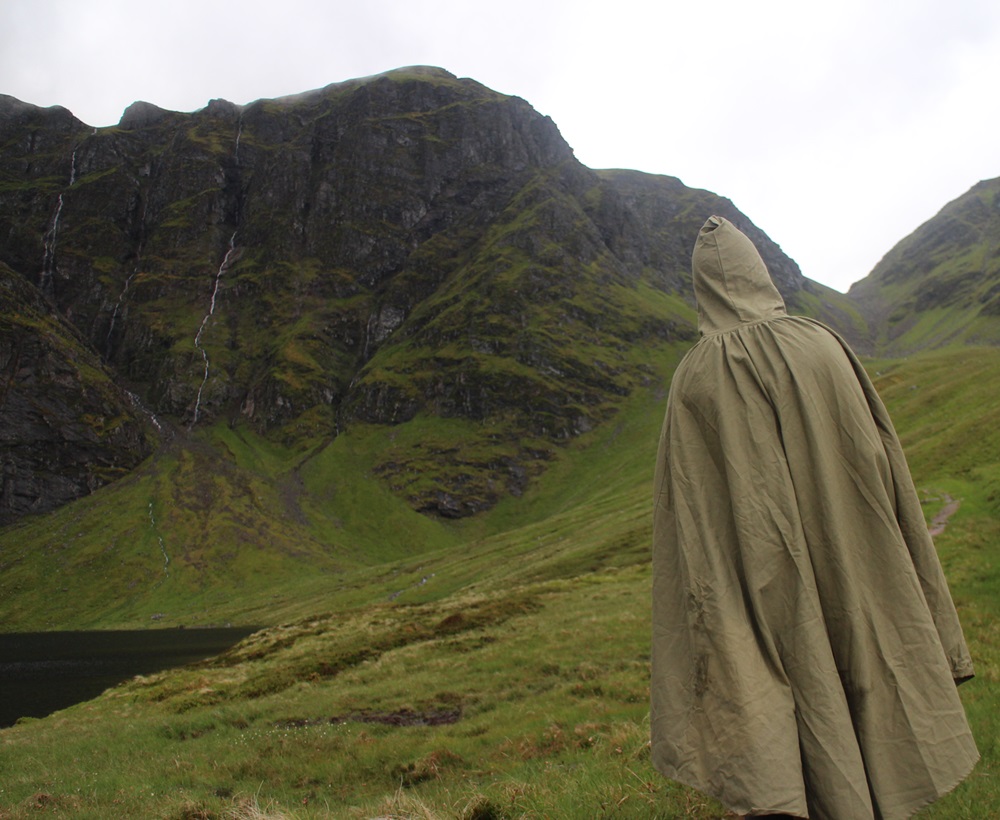
In the intervening years, a similar place had found its way into our narrative, making the return even more momentous. As we neared Coire Àrdair, birch trees gleamed silver against low clouds, guiding us onwards. The river Allt Coire Àrdair murmured secrets about the hidden lochan from which he issued. As the trail steepened, the wind funnelled through the corrie in a steady howl. The mountains hailed our coming.
As we reached The Window, we raised our voices, echoing the roar of a being in our stories who takes the form of a prehistoric Irish Elk and who, from his place within the col, cries out for a damaged world.
These special recitations are never filmed; they are purely personal, affirming and strengthening the bond between me and my twin, as well as our mutual respect for nature as the origin of all things.
Speaking and singing in nature has given me confidence and helped me connect with the ecosphere in ways that field studies, writing or other forms of art cannot. I therefore encourage readers to try it for themselves. Indeed, in a world where people are often mocked for expressing love or concern for the Earth, or where the constant racket of human activity eliminates even the slightest urge to reflect, it becomes all the more important to speak up for nature. Without receptive listening and intentional opening of the mouth, we cannot find ourselves inside a song and be, as Ingold suggested, ‘immersed from the start, like other creatures, in an active, practical and perceptual engagement with constituents of the dwelt-in world’.15 In finding our voice, we find our place in the world.
But it isn’t always easy. As folk singer Sam Lee — an advocate of walking and singing outdoors — reminds us, ‘Shyness and scepticism always need overcoming’.16 Lee encourages us to forget our fears by remembering that the practice ‘is intercultural and millennia-old, and demands new blueprints for today’s reconnective needs’.17 For those still unsure, I suggest starting small: recite a short poem under a tree, hum a melody by a riverbank, whisper to the birds at dawn. Over time, it may become second nature. Through such gestures, however modest, we begin to tune ourselves back into the symphony of the living world.
In an age of obnoxious anti-Earth imperatives like ‘drill, baby, drill’, calling for solidarity has never been more important, since these slogans see Earth as nothing more than a mute object to be hollow out. But people are singing back. For example, The Climate Choir Movement, launched in Bristol in 2022, now has over 600 members across 11 choirs in England and Wales. They use harmonious protest to deliver climate messages, often stirring strong emotional responses. Musical director Kate Honey writes: ‘Protest hardens hearts by shouting and chanting but we don’t want hearts to be hardened: it’s very important not to fall out with each other if we want change to happen’.18 This approach accords with my own view that nature engagement is strongest when it is tied to peaceful practices and immemorial cycles and traditions, as I have argued in this outlet and elsewhere.19
Finally, Sing For Earth Day is now partnering with Earth Day for its 55th anniversary. This group organizes global song, dance, and music events to foster unity and address the climate crisis through creativity and connection.20

This Earth Day, use your voice for nature. Whether privately or communally, become like the Geoglossaceae — the Earth tongues — rooted in the soil and rising to sing.
Footnotes
- Roger Scruton, Understanding Music: Philosophy and Interpretation (London: Continuum, 2009), p. 5. ↩︎
- Patrick Curry, Art and Enchantment: How Wonder Works (Abingdon: Routledge, 2023), p. 128-29. ↩︎
- Tim Ingold, The Perception of the Environment: Essays on Livelihood, Dwelling and Skill (London: Routledge, 2000), p. 26. ↩︎
- Ibid., p. 57. ↩︎
- David Abram, The Spell of the Sensuous: Perception and Language in a More-Than-Human World (New York: Vintage Books, 1996), p. 22. ↩︎
- Curry, Art and Enchantment, pp. 122-23. ↩︎
- Ibid., pp. 125-27. ↩︎
- Hansjoerg P. Kunc and Rouven Schmidt, ‘The Effects of Anthropogenic Noise on Animals: A Meta-Analysis’, Biology Letters, 15.11 (2019), 20190649 <https://doi.org/10.1098/rsbl.2019.0649>. ↩︎
- Omar Hahad, Marin Kuntic, Sadeer Al-Kindi, Ivana Kuntic, Donya Gilan, Katja Petrowski, Andreas Daiber, and Thomas Münzel, ‘Noise and Mental Health: Evidence, Mechanisms, and Consequences’, Journal of Exposure Science & Environmental Epidemiology, 35 (2025), 16–23 <https://doi.org/10.1038/s41370-024-00642-5>. ↩︎
- Patrick Curry, Enchantment: Wonder in Modern Life (Edinburgh: Floris Books, 2019), p. 22. ↩︎
- J.R.R. Tolkien, The Fellowship of the Ring (London: HarperCollins, 2007), p. 457. ↩︎
- While this poem carries an inherent urgency reflecting Eärendil’s journey, we sometimes choose to perform it even more swiftly. While this approach may sacrifice the subtleties and richness of the performance, it is for us another way of respecting the text by demonstrating how deeply ingrained it has become. The same is true of some of our other recitations. ↩︎
- J.R.R. Tolkien, The Two Towers (London: HarperCollins, 2007), p. 932. ↩︎
- Ibid., p. 656. ↩︎
- Ingold, p. 42. ↩︎
- Sam Lee, ‘Singing Our Way Back to Nature’, The Ecologist, 22 July 2022, <https://theecologist.org/2022/jul/22/singing-our-way-back-nature> [accessed 14 April 2025]. ↩︎
- Ibid. ↩︎
- Amelia Hill, ‘“A powerful message through song”: the UK’s Climate Choir Movement is growing’, The Guardian, 7 February 2024, <https://www.theguardian.com/world/2024/feb/07/a-powerful-message-through-song-the-uks-climate-choir-movement-is-growing> [accessed 14 April 2025]. ↩︎
- Taylor Hood, ‘Just Save Perception’, Earth Tongues, 12 August 2024, <https://blog.ecologicalcitizen.net/2024/08/12/just-save-perception/> [accessed 15 April 2025]; Taylor Hood, ‘Defiance in Half-Light’, Elsewhere Journal, 17 July 2024, <https://www.elsewhere-journal.com/twilight-posts/2024/7/17/defiance-in-half-light/>[accessed 20 April 2025]. ↩︎
- Sing For Earth Day, Our aims and vision (n.d.) <https://www.singforearthday.co.uk/> [Accessed 15 April 2025]. ↩︎
Bibliography
Abram, David, The Spell of the Sensuous: Perception and Language in a More-Than-Human World (New York: Vintage Books, 1996)
Curry, Patrick, Art and Enchantment: How Wonder Works (Abingdon: Routledge, 2023)
———, Enchantment: Wonder in Modern Life (Edinburgh: Floris Books, 2019)
Hahad, Omar, Marin Kuntic, Sadeer Al-Kindi, Ivana Kuntic, Donya Gilan, Katja Petrowski, Andreas Daiber, and Thomas Münzel, ‘Noise and Mental Health: Evidence, Mechanisms, and Consequences’, Journal of Exposure Science & Environmental Epidemiology, 35 (2025), 16–23 <https://doi.org/10.1038/s41370-024-00642-5>
Hill, Amelia, ‘“A powerful message through song”: the UK’s Climate Choir Movement is growing’, The Guardian, 7 February 2024, <https://www.theguardian.com/world/2024/feb/07/a-powerful-message-through-song-the-uks-climate-choir-movement-is-growing> [accessed 14 April 2025]
Hood, Taylor, ‘Defiance in Half-Light’, Elsewhere Journal, 17 July 2024, <https://www.elsewhere-journal.com/twilight-posts/2024/7/17/defiance-in-half-light> [accessed 20 April 2025]
———, ‘Just Save Perception’, Earth Tongues, 12 August 2024, <https://blog.ecologicalcitizen.net/2024/08/12/just-save-perception/> [accessed 15 April 2025]
Ingold, Tim, The Perception of the Environment: Essays on Livelihood, Dwelling and Skill (London: Routledge, 2000)
Kunc, Hansjoerg P., and Rouven Schmidt, ‘The Effects of Anthropogenic Noise on Animals: A Meta-Analysis’, Biology Letters, 15.11 (2019), 20190649 <https://doi.org/10.1098/rsbl.2019.0649>
Lee, Sam, ‘Singing Our Way Back to Nature’, The Ecologist, 22 July 2022, <https://theecologist.org/2022/jul/22/singing-our-way-back-nature> [accessed 14 April 2025].
Scruton, Roger, Understanding Music: Philosophy and Interpretation (London: Continuum, 2009)
Sing For Earth Day, Our aims and vision (n.d.) <https://www.singforearthday.co.uk/about.html> [accessed 15 April 2025)
Tolkien, J.R.R., The Fellowship of the Ring (London: George Allen & Unwin, 1966; London: HarperCollins, 2007)
———, The Two Towers (London: George Allen & Unwin, 1966; London: HarperCollins, 2007)
Share your thoughts with the author
This message will be emailed to the author (and will not be published).


 Earth Tongues