



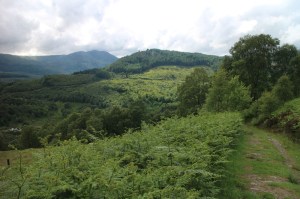
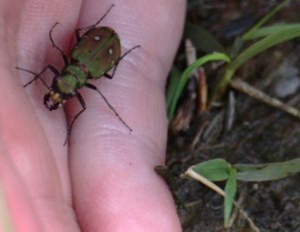
Seven years ago, my twin and I found ourselves hiking through Glen Finglas in the Scottish Highlands. Time has rendered the details of our journey hazy, yet there remains a lasting impression of joy at the profusion of life that nature deigned to reveal to us. As a lover of Coleopterans, I was most captivated by the many beetles we encountered, such as ground and rove beetles. It was especially thrilling to spot a green tiger beetle (Cicindela campestris) darting this way and that across the trail. This species is said to sacrifice vision for speed as it hunts, becoming momentarily unable to discern the world around it. Humans, in moments of strong emotion or action, often find themselves blinded in the same way.
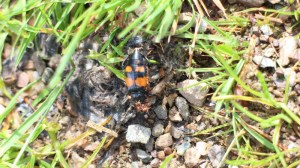
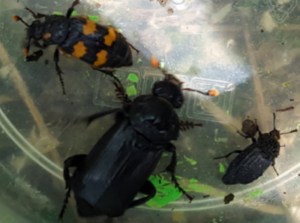
As we were retracing our steps, filled with the love of life, my twin discovered another beetle crawling not over grass or stone, but on a mound of flesh and fur. It was a Silphid — a carrion beetle. Its large size and vibrant orange markings enchanted us. Kneeling closer, we discovered tiny red creatures scuttling over its head and pronotum. We took these minute arachnids for parasites, ascribing to them the same kind of ‘disgust-imbued fear’ many experience in relation to a broader entomophobia.1 In this case, we feared for the Silphid and fretted about the best course of action to take. Eventually, after being sanctioned by me, my twin picked up a stone.
Even we who love nature are limited in understanding and always susceptible to prejudice. This is unavoidable since ‘humans and everything about them is ultimately limited, because we are parts of a much, perhaps infinitely, greater whole; so our knowledge too is necessarily limited and open, in principle, to correction’.2 As such, it’s necessary to cultivate an attitude of receptivity and openness, especially in our encounters with nonhuman agencies. Paradoxically, accepting that one doesn’t know anything for certain can be affirming: ‘But I do not know and do not know and hold onto it/ as to a saving bannister’.3 If only we’d taken this view. It might’ve saved lives, and my conscience.
The reader may find it easier to forgive my twin, since, although a friend to nature’s creations, he couldn’t have known. I, on the other hand, had spent several years formally studying wildlife ecology and conservation (through two separate courses) and many more engaged in amateur naturalism. I’d been obsessed with memorising beetle genera and may even have had an inkling about Silphids at that time. But what has troubled me most of all is that the deaths could’ve been avoided with recourse to online identification tools or a general internet search. Though I have an aversion to the use of digital aids in wildlife identification — I’d brought nothing but a physical Francis Rose wildflower key — this would’ve immediately put an end to our worries. To conduct any kind of search simply hadn’t crossed my mind, which was by then overwhelmed with sympathy for the beetle.
My frustration is compounded by the fact that Silphids are truly unique.4 Species in the necrophagous sub-family Nicrophorinae care for their young by locating small dead mammals, such as mice and shrews, which they bury and clean with enzymes. The female lays her eggs near the carcass, and both parents help feed and protect the larvae from competition in the form of maggots and moulds. The parents look after the larvae until they pupate, at which point they depart. This bi-parental brood care is rare in insects. As for the parasites, they were none other than Poecilochirus mites, with whom Silphids share a commensalistic relationship. These creatures hitch rides on unperturbed beetles to new carrion sources, whereupon they feed on fly eggs and larvae. We’d taken them for nothing more than symbols of death and valued the Silphid over them. We’d killed in order to save.
What makes our well-intentioned but ultimately destructive decision worse is that anthropogenic habitat loss and land use change negatively affect carrion beetle populations. For example, one study found that forest extent is a critical determinant of Silphid diversity, with large deciduous forests supporting greater burial activity and species abundance and richness.5 Furthermore, fragmented landscapes can create a hostile matrix, impeding gene flow in carrion beetles, such as Nicrophorus vespilloides.6 Another landscape-scale analysis of Silphid assemblages on piglet cadavers showed that extensive forest management reduced the abundance of N. humator, suggesting its potential as an indicator species for anthropogenic disturbances in Central European forests.7 Such findings, among many others, highlight how detrimental human actions can be for this underappreciated family.
Whenever I dwell on the beetle’s crushed body, I want to stand still and not allow myself to take pleasure from life in any way, like a Jain practising ahimsa. To the best of my knowledge, the incident in the Trossachs is the only time I’ve consciously harmed a nonhuman, albeit indirectly, aside from some intensely frustrating reactions caused by an ingrained arachnophobia. In the weeks that followed, I had to admit that I lacked the necessary humility to second-guess myself regarding the mites. However, the incident ultimately produced an even stronger attitude of care towards nonhumans. Natural history, as Thomas Fleischner has argued, can do this since ‘immersion in the complexity, the unpredictability, and, occasionally, the ferociousness of the natural world almost always teaches humility’.8 This is the way of genuinely empathetic natural history, practiced as a ‘spiritual path’ and not as a means to an end.9 Sadly, many naturalists — entomologists in particular — accept without hesitation the practice of harming or even killing hundreds of insects in the name of conservation.
The death of the carrion beetle ultimately led me to devote my undergraduate dissertation to the family Silphidae. In the months prior to my project, our class visited Oxford’s Natural History Museum and were given a tour by Darren Mann, an expert on dung beetles (Geotrupidae). After telling him about my plans, Darren presented with me a case full of pinned Silphids. Seeing so many different examples — here were N. interruptus, Oiceopotema thoracicum and Necrodes littoralis — excited me greatly. Then a sense unease of crept in. These beetles had by now become friends through close research, so it was doubly shocking to see rows and rows of them dead.
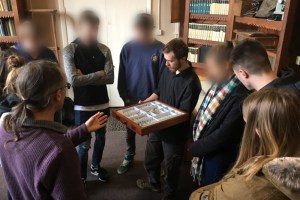
Later, just before starting my dissertation fieldwork, I attended a two-day workshop dedicated to Silphid recording. We identified beetles under microscopes, learnt about their ecology, and dug up pre-interred carcasses to find live specimens. I embraced these tasks since I’ve always tried to value nature’s raw, grounding realities. However, I couldn’t shake my disquiet when examining yet more Silphids terminated for study purposes. My discomfort reached its peak when a researcher spoke matter-of-factly about ending the lives of hundreds of beetles for an MRes thesis. While their passion was clear, the act revealed stark cognitive dissonance. Is one life — or hundreds — justified for research, even if it aids conservation?

I find it difficult to support killing even in situations where it serves vital ecological restoration efforts, such as deer culling. To destroy hundreds of insects for the purpose of accountability and reproducibility in research (voucher specimens) or to provide the breadth of material needed for taxonomic and comparative studies (reference collections) seems to me misguided. Joe Gray has voiced similar concerns, arguing for the adoption of compassionate entomology, which he defines as ‘a way of studying insects and other arthropods that upholds the intrinsic value and welfare interests of the individual focal organisms’.10 While acknowledging the complexities of entomological research needs, he challenges the prevailing viewpoint that ‘the goal of attaining more knowledge and greater understanding generally trumps concerns for the survival and well-being of individual organisms’.11 This perspective invites a critical re-evaluation of entomological practices, urging researchers to balance scientific advancement with ethical responsibility toward the living beings they study.
But we’ve a long way to go. At the start of my undergraduate studies, reading E. O. Wilson taught me that even prominent environmentalists are capable of treating insects with downright cruelty propped up by anthropocentric reasoning. In one passage, which functions as a mere aside, the eminent myrmecologist and renowned biodiversity champion describes how one can smell the alarm pheromone of a bee by ‘crush[ing] the sting and the organs between two fingers’.12 If this sounds cruel, Wilson assures us that we needn’t ‘feel bad about killing a worker bee’ because an individual ‘has an adult life span of only about a month, and it is only one of tens of thousands that make up a colony’.13 Insects stand little chance when even heralded figures such as Wilson — let alone the general public, who often see them as nothing but nuisances — deem it acceptable to kill them simply to satisfy human curiosity. No wonder entomologists, driven by lofty conservation goals and notions of scientific progress, don’t hesitate to use harmful or lethal methods, such as sweep netting, ethanol immersion, carbon dioxide exposure or freezing. Wilson’s callousness stuck with me for years.
I was determined to avoid killing Silphids or any other nonhuman beings in my project, which examined whether larger, contiguous woodlands support greater species abundance and species richness. For twenty-eight days during the summer of 2018, I spent every evening crouched over pitfall traps baited only with rotting chicken wings — and no lethal solutions. Sixteen traps distributed across four deciduous woodland patches (of two size classes), combined with the need to replace baits, kept me perpetually on the move. After capturing the beetles, I identified them on-site using a specialised key, though I often took photos to avoid detaining the beetles any longer than necessary. I then marked each individual with non-toxic paint for mark-release-recapture and returned them to their homes. This exhausting process served as my penitence. Other researchers collect buckets brimming with dead insects, some of them even, perhaps, whistling a tune on their way out of the woods.
As far as I know, I never directly harmed any beetles. However, I still regret marking them with paint, which likely caused them distress and may have increased their vulnerability to predators. And, unable to procure ethically sound small mammal carcasses, I had relied on store-bought chicken. My choice supported the industrial farming of chickens — a system notorious for its cruelty and disregard for animal welfare. This ethical lapse weighs on me, as it underscores the complexity of striving for conscientious research while inadvertently perpetuating other forms of harm. The whole experience has led to an ongoing existential crisis regarding this part of my ecology education.

I could’ve chosen a safer and less ethically problematic project, such as studying juniper (Juniperus communis) distributions or recording red kite (Milvus milvus) activity, but my curiosity about carrion beetles led me down a more unconventional path. I was the only student at University Centre Sparsholt to ever study carrion beetles. Unfortunately, as a bachelor’s project, my work was never going to be published, even though it was well received. Overall, the dissertation was an exercise in ecological fieldwork, scientific principles, and data analysis.
Though I first connected with nature through storytelling as a teenager, I pursued courses in wildlife ecology and conservation, as well as countryside management, to make a practical difference.14 Over five years, I carried out tasks like coppicing, tree planting/felling, hedge-laying, scrub clearance, and controlled burns, alongside ecological fieldwork ranging from habitat mapping (Phase One and National Vegetation Classification surveys) to studies of individual species (e.g., of bats and newts). Such efforts can help us understand and restore ecosystems. However, at higher levels of study, a focus on knowledge accumulation and instrumentalism often overshadows the intrinsic value and personhood of individual beings, especially regarding apparently expendable arthropod taxa. Researchers too often permit ‘saving’ at any cost.
The issues I’ve explored in this essay, along with other theoretical and professional concerns, has led me to step away from the field of ecology. On a more personal level, these doubts about my own and other human actions have tempered my engagement with nature, even in positive situations, such as countryside volunteering. While practical work in the outdoors once defined my life, for now, I’ve set aside both the billhook and the quadrat, content to observe nature quietly and reflectively in my own brand of natural history.
I try to honour nature softly and at a distance these days, in postgraduate study and beyond, by exploring narratives. One false narrative it’s absolutely necessary to continue to challenge is the one that tells us that insects and other arthropods are unworthy of the same ethical consideration we afford to other forms of life, largely due to their large numbers, short life spans and perceived level of danger. True, we occasionally associate these animals with positive traits — butterflies are beautiful and ants industrious — but Western culture often frames them as entities that only ‘invade, evade, overwhelm, attack, perturb, and defy’.15 The vast majority are harmless to us and always blameless. After all, symbiosis, or at least neutral relations, far outweigh competition in nature, like that between the beetle and its mites.
For my part, I ritualise contemplation about Silphids. I attain a sense of reverence in dwelling on their secret Earthly workings out there in depths of the night, bringing forth life from death. To me, these beetles are emblematic of the many shunned creatures of this world who rarely enter our minds or, if they do, find only scorn therein. At the risk of anthropomorphising, I associate their plight, and that of their friends the phoretic mites, with Frankenstein’s creation. The negative perception of that entity constructed by a man (of science) and fixed in the minds of humanity took root for no fault of his own:
They are kind—they are the most excellent creatures in the world; but, unfortunately, they are prejudiced against me. I have good dispositions; my life has been hitherto harmless and in some degree beneficial; but a fatal prejudice clouds their eyes, and where they ought to see a feeling and kind friend, they behold only a detestable monster.16
Insects, even those associated with death and decay, are not monsters, nor do they mean us harm. As well as having intrinsic value, they are agents of renewal.
In my encounters with carrion beetles, I feel blessed to have gained a fuller appreciation for them that few are able to experience. Sadly, and strangely, I haven’t encountered a single other Silphid since my dissertation, though I’m always on the lookout, turning over deceased hedgehogs, shrews and voles, respectfully, whenever and wherever death greets me. Every encounter with the death of a nonhuman animal is an opportunity for meditation on the insect whose life I inadvertently ended, as well as a reminder of how little time we have to understand anything about this vast more-than-human world. And we have a lot to learn.
It has taken me seven years to summon the courage to write this apology. My hope is that these words could stop another human from acting as rashly as I did. To that end, if as a nature enthusiast you find yourself unsure of a situation, take a moment to reflect and gather yourself. Often, the best course of action is to refrain from intervening in nature’s ways for any reason, even if a nonhuman being is genuinely imperilled. And for those studying conservation, I know you mean well, but it’s important to consider whether there’s a more caring approach to your work. We owe the adoption of compassionate entomology to insects, those myriad wonders to whom this planet truly belongs.
Footnotes
- Jeffery Lockwood, The Infested Mind: Why Humans Fear, Loathe and Love Insects (Oxford: Oxford University Press), p. 1. ↩︎
- Patrick Curry, Ecological Ethics, rev. 2nd edn (Cambridge: Polity Press, 2017), p. 27. ↩︎
- Wisława Syzmborska, ‘Some Like Poetry’, in Miracle Fair: Selected Poems of Wisława Szymborska, trans. Joanna Trzeciak (New York: W.W. Norton & Co., 2001), p. 139, 17. ↩︎
- For an overview, see Jessica Dekeirsschieter, François Verheggen, Georges Lognay, and Eric Haubruge, ‘Large carrion beetles (Coleoptera, Silphidae) in Western Europe: a review’, Biotechnology, Agronomy, Society and Environment, 15.3 (2011), 435–47 <https://www.researchgate.net/publication/224579152
_Large_carrion_beetles_Coleoptera_Silphidae_in_Western_Europe_A_review> [accessed 29 December 2024]. ↩︎ - Jordan M. Wolf and James P. Gibbs, ‘Silphids in Urban Forests: Diversity and Function’, Urban Ecosystems, 7.4 (2004), 371–84 <http://dx.doi.org/10.1007/s11252-005-6836-6>. ↩︎
- Sarah Pascoal and Rebecca M. Kilner, ‘Development and Application of 14 Microsatellite Markers in the Burying Beetle Nicrophorus vespilloides Reveals Population Genetic Differentiation at Local Spatial Scales’, PeerJ, 5 (2017), <https://doi.org/10.7717/peerj.3278>. ↩︎
- Christian von Hoermann, Dennis Jauch, Carolin Kubotsch, Kirsten Reichel-Jung, Sandra Steiger, and Manfred Ayasse, ‘Effects of abiotic environmental factors and land use on the diversity of carrion-visiting silphid beetles (Coleoptera: Silphidae): A large scale carrion study’, PLOS ONE, 13.5 (2018), <https://doi.org/10.1371/journal.pone.0196839>. ↩︎
- Thomas Fleischner, ‘The enduring and elemental importance of natural history’, The Ecological Citizen, 8.1 (2025), 43–51 <https://www.ecologicalcitizen.net/article.php?t=enduring-elemental-importance-natural-history> [accessed 20 December 2024], p. 47. ↩︎
- Ibid. ↩︎
- Joe Gray, ‘Making a case for compassionate entomology’, Earth Tongues, 10 December 2024, <https://blog.ecologicalcitizen.net/2024/12/10/making-a-case-for-compassionate-entomology/> [accessed 29 December 2024]. ↩︎
- Ibid. ↩︎
- E.O. Wilson, Letters to a Young Scientist (New York: Liveright, 2013), p. 194. ↩︎
- Ibid. ↩︎
- In this context, “management” does not mean tidying up, quantifying or controlling nature. Instead, it means enhancing structural diversity and preserving biodiverse assemblages and features wherever possible. This course taught us to make ecosystems “messy” and to value the old and decaying–a common ethos in conservation. ↩︎
- Lockwood, p. 37. ↩︎
- Mary Shelley, Frankenstein: Or the Modern Prometheus, ed. Maurice Hindle (London: Penguin Classics, 2003), p. 136. ↩︎
References
Curry, Patrick, Ecological Ethics, rev. 2nd edn (Cambridge: Polity Press, 2017)
Dekeirsschieter, Jessica, François Verheggen, Georges Lognay, and Eric Haubruge, ‘Large carrion beetles (Coleoptera, Silphidae) in Western Europe: a review’, Biotechnology, Agronomy, Society and Environment, 15.3 (2011) 435-47, <https://www.researchgate.net/publication/224579152
_Large_carrion_beetles_Coleoptera_Silphidae_in_Western_Europe_A_review> [accessed 29 December 2024]
Fleischner, Thomas, ‘The enduring and elemental importance of natural history’, The Ecological Citizen, 8.1 (2025), 43–51 <https://www.ecologicalcitizen.net/article.php?t=enduring-elemental-importance-natural-history> [accessed 20 December 2024]
Gray, Joe, ‘Making a case for compassionate entomology’, Earth Tongues, 10 December 2024, <https://blog.ecologicalcitizen.net/2024/12/10/making-a-case-for-compassionate-entomology/> [accessed 29 December 2024]
Lockwood, Jeffery, The Infested Mind: Why Humans Fear, Loathe and Love Insects (Oxford: Oxford University Press)
Pascoal, Sarah and Rebecca M. Kilner, ‘Development and application of 14 microsatellite markers in the burying beetle Nicrophorus vespilloides reveals population genetic differentiation at local spatial scales’, PeerJ, 5 (2017) <https://doi.org/10.7717/peerj.3278>
Shelley, Mary, Frankenstein: Or the Modern Prometheus, ed. by Maurice Hindle (London: Penguin Classics, 2003)
Szymborska, Wisława, ‘Some Like Poetry’, in Miracle Fair: Selected Poems of Wisława Szymborska, trans. Joanna Trzeciak (New York: W.W. Norton & Co., 2001), p. 139
von Hoermann, Christian, Dennis Jauch, Carolin Kubotsch, Kirsten Reichel-Jung, Sandra Steiger, and Manfred Ayasse, ‘Effects of abiotic environmental factors and land use on the diversity of carrion-visiting silphid beetles (Coleoptera: Silphidae): A large scale carrion study’, PLOS ONE, 13.5 (2018) <https://doi.org/10.1371/journal.pone.0196839>
Wilson, E. O., Letters to a Young Scientist (New York: Liveright, 2013)
Wolf, Jordan M. and James P. Gibbs, ‘Silphids in Urban Forests: Diversity and Function’, Urban Ecosystems, 7.4 (2004), 371–84 <http://dx.doi.org/10.1007/s11252-005-6836-6>
Share your thoughts with the author
This message will be emailed to the author (and will not be published).


 Earth Tongues