


This post is part of a series titled ‘Beneath the birch and pine’, whose uniting theme—beyond the writer’s nature-centred standpoint—is the inspiration that each piece finds in some aspect of life in the Scottish Highlands. For an associated photography project, which is called ‘The Cairngorms Up-Close’, please head here; and to download a digital imagebook titled ‘Strathspey Up-Close’, please visit here.
My aim here is to say something about the ways in which we experience, or behold, wild nature in the modern world. So that there is no misunderstanding from the outset, let me state that the kind of lie to which I refer in the title of this piece is the setting in which beholders find themselves, rather than any deception for which they might later be responsible in describing what they have witnessed. Were I intending this second meaning, an entirely different piece could be written, decrying filtered photos on Facebook or twisted tweetings on… (oh!)… X.
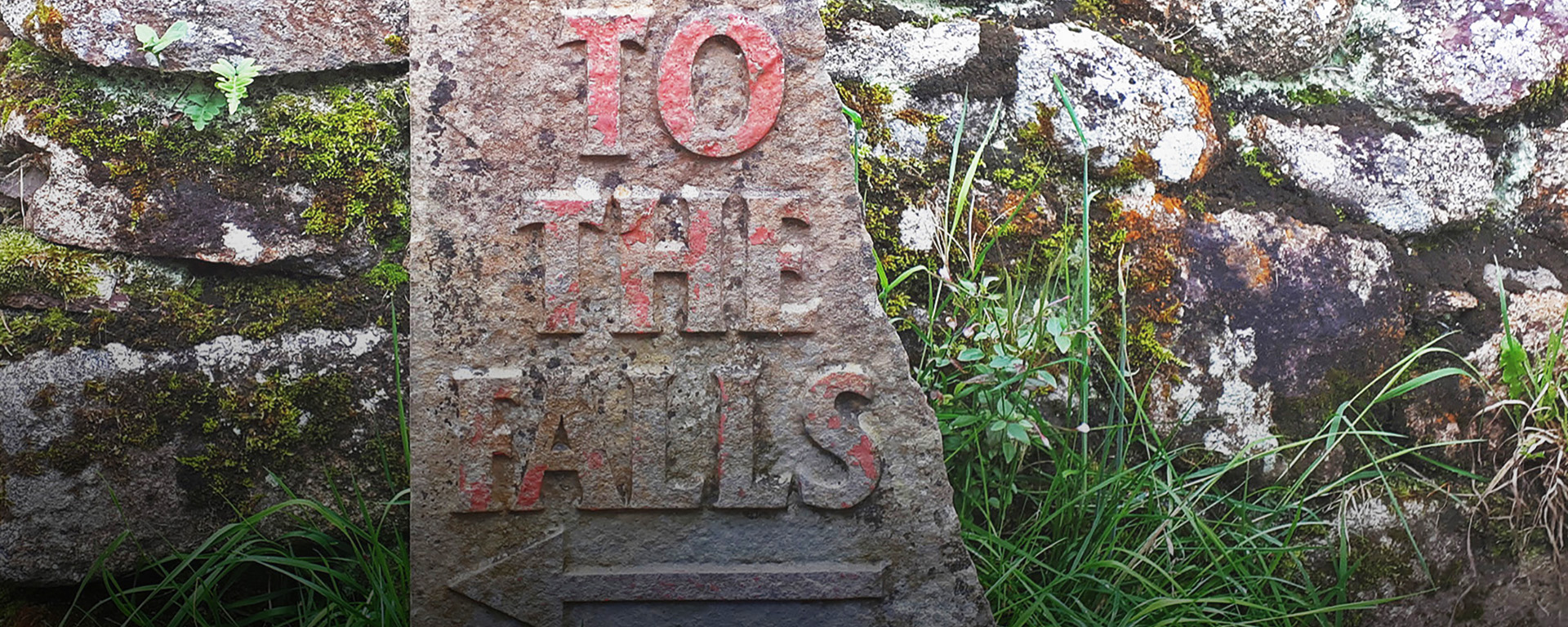
My reference to the first meaning will become apparent as I bemoan the marks of civilization that detract from visits to celebrated beauty spots in the overdeveloped world. Inspiration for this piece came from a recent bus trip that I took in the Scottish Highlands. The name of my destination and its famed waterfall are anonymised for their protection (not that you, dear reader, would do anything to harm them). With regard to this decision, it must be noted that the work of the stonemason highlighted in the photo at the top was obligingly generic.
Descent
I stand by the side of a narrow asphalted highway, at the gateway to a path. Marked by an embossed arrow on a partially buried stone, this trail leads down into the woods. Back across the road from me there is a little-used bus stop, and behind that a car park filled with vehicles ranging in size from superbikes to six-wheeled motorhomes. People are milling about, taking photos of themselves, examining plastic items purchased from the gift shop, reading the information board, and generally enjoying life, as I pass through the hinged wooden gate and under the canopy. The forest greets me with a rain of age-goldened birch leaves—an early sign of autumn’s approach.
The path down through the trees is of the sanitized kind, with cut steps, handrails, and sufficient width for oncoming recreationalists to pass without slowing down. In this part of the world, it is customary to exchange at least a minimal greeting with strangers on the trail, but here there is a feeling of a conveyor belt, and glances are hard to meet.
Closely spaced signposts update me on how much farther I will be walking in my descent, and soon I arrive at the viewpoint: an area offering space for five or six people that is hemmed in on three sides by a triple-runged metal railing. I await my turn, step forward (to receive my dose of untamed nature), gaze briefly at the rushing cataract and the peat-tinged pool receiving her liquid wealth, and then move away, sensing the pressure of smartphone-clutching hands behind me. I make a mental note to reread Jack Turner’s Abstract Wild. (Some days later I do this and find an apt passage: “Many feel the pervasive Disneyesque and museumlike quality of wilderness areas, national parks, and wildlife preserves, but they continue to believe these places provide a sanctuary from human artifice.”)
On the other side of the metal guard, a discarded coffee-cup, caught in a rock-hugging bush, is kept out of my reach by the protective railing. There is always rubbish in such places, and yet I find it hard to conceive of a soul who values beauty spots enough to expend energy in visiting them but then behaves with such a lack of respect. Another challenge for the imagination lies in fathoming the person who goes to the effort of putting dog muck into a disposable bag, only to leave it hanging on the twig of a tree. This last act is one I find particularly irksome when it occurs in nature reserves—places that are sacred to me. Think of someone walking into a building of worship and hooking the handles of a small shit-filled sack over a corner of the altar or some decorative detail on the pulpit.
I realize that I should have alerted you to this unpleasant turn in the prose before you got to it, in case you were in the middle of a snack or a fuller meal. In any case, I urge all readers—even those with the strongest of stomachs—to skip over the next two paragraphs. You can safely rejoin the piece where it gets marginally more highbrow, with the sentence that begins “There is a more philosophical conundrum…” (and I have even taken the trouble of emboldening and italicizing those words to facilitate an easy re-entry).
If I am good at anything in life, it is locating and collecting litter in wild places. (Why have you not jumped ahead? You have been warned!) I am good because I have studied behaviours and identified patterns. While I cannot always grasp what it is that makes people do the things they do, I know the side-paths to go down, the kinds of tree to look behind, and—even in an area that is new to me—the spots that call for a cigarette break. Aiding my predictive abilities is a phenomenon explored in The Walker’s Guide to Outdoor Clues and Signs by Tristan Gooley (a giant on whose shoulders I perch as a student of the outdoors). The phenomenon is that you do not need to know what any one recreationalist will do in the wild to accurately foretell the impact of many such individuals.
Despite my expertise in this small aspect of human existence, I am confronted every now and again by something that bursts the sphere of my expectations. Once, for instance, I found a whole celeriac in a clear plastic bag where a bridleway passed under a railway bridge. Another time, I came across single gloves from three different pairs all pierced onto a large metal ring. And then there was the juniper bush. Growing by a bench that bore a dedication to a recently deceased couple, and which offered a staggeringly beautiful outlook across a pine forest to the arctic mountain plateau beyond, this spiny shrub had been decorated with nine untied and awkwardly snagged carrier bags, each of them containing excrement. Based on other items left scattered in the vicinity, the organic matter was almost certainly human in nature. I was grateful that I had packed my rubber gloves.
There is a more philosophical conundrum that I find myself pondering when I head speculatively off the primary path to follow some little-trodden spur (the bold italics were helpful, weren’t they). The conundrum is this: Is it good if I spot a piece of litter, because then it can be removed, or is it better if I don’t find anything, because then it wasn’t there? While this, I grant you, is not quite Schrödinger’s crisp packet, it is a poser nonetheless. There is a lot more still that I could say about rubbish, but the time has come to return to the main track of this piece.
Climbing back up
“Sight-seeing is the art of disappointment,” penned Robert Louis Stevenson in The Silverado Squatters. And as I begin the return ascent, I am feeling somewhat empty. The experience of witnessing this fine waterfall was unsatisfactory. It had seemed as if I was in a bubble peering out, unable to make a real connection with the sight in my eyes and the tumult in my ears, or even the spray of mist on my cheeks. My senses had been numbed by the clamour of tourism at the trailhead, and they had recovered little along the wildness-purged walkway or among the swarm of devices at the viewpoint.
Adding to my discontent, as I continue back up the slope, is a nagging sense of conformism in my chosen activity. I have been following arrows along a trail, reaching a site marked with a star on the tourist map, and ticking off something from the area’s must-see itinerary. I have been doing what society expects of me. Yet, to experience the wild fully is to take nature as one’s sole guide. And, other than in my awareness of the rain of leaves, I could hardly have given less attention to her pointers.
Slowly, however, my outlook grows more charitable. An older lady, who is stuttering down the slope towards me and clutching the handrail with every second step, smiles to herself with what I presume is gratitude for the aid to accessibility. And then there is the good job that the path does in spatially restricting human presence in this nature-rich environment. I certainly do not wish to trample my own route to a private vista.
To expand on that last point, I live my life caught between conflicting impulses: on one hand, a wish to escape the shackles of human management; and, on the other, a reticence—out of ecological respect—to roam beyond its already-excessive bounds. Happily, there are ways to experience nature in which I can go some way to satisfying these twin wants.
There are trails where the human touch has been light; where it is possible to know peace; and where the pathway is itself a microhabitat—for pit-dwelling tiger beetle grubs, nest-mining solitary bees, and sun-hungry vipers. On such routes, I can find the potent connection with more-than-human life that I crave. More surprisingly, perhaps, my dual desires can also be fulfilled in the domain of dereliction. I receive a deep injection of hope each time that I encounter species-rich ecologies in the wake of abandonment.
And then, in something that combines all of these qualities, there is the dilapidated pathway…
Emergence
I complete the last part of the short return walk to the trailhead; and, still feeling far from sated, I head quickly away from the hubbub and the petrol fumes and along a different track. This one I have to myself.
The path begins by crossing an old stone bridge upstream from the fall. Here, the water’s course has no dramatic cascade. But on a tiny stone island around which the river eases, a white-throated dipper bobs with the eponymous movement of his kind, before plunging under the surface in search of food. The bird’s American counterpart, the water ouzel, was given a whole chapter by John Muir in his Mountains of California, such was his adoration for these semi-aquatic wonders. In one passage, the great naturalist wrote:
He is the mountain streams’ own darling, the humming-bird of blooming waters, loving rocky ripple-slopes and sheets of foam as a bee loves flowers, as a lark loves sunshine and meadows.
My love and admiration is, I believe, as strong as Muir’s was, and I delight in the dipper’s company for some time before continuing along the path. After skirting a grassy field, I am delivered into an evergreen-dominated woodland on the sloping ground above a large loch. At a fork I bear right, and soon a curious sight draws my eye away from the trail. In a boggy opening, where scattered conifers grow with stunted forms and undernourished yellow needles, a boardwalk slumps in disrepair.
The side-track that leads to the start of the wooden path has been part-way reclaimed by the bordering vegetation. I follow this disappearing trail and, once on the boardwalk, dig out a camera. This leaves me open, of course, to accusations of hypocrisy; yet, I could not resist the urge to document such a fine example of a dilapidated pathway.
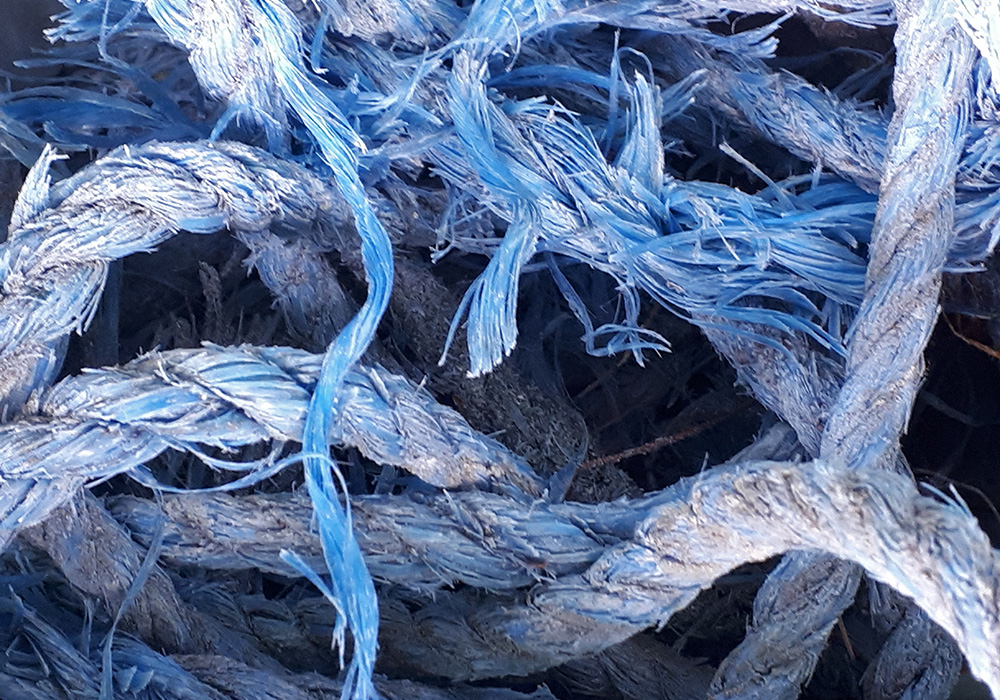
A number of the cross-planks have snapped. Most of the blue-tinted barrier rope has disappeared. The far terminus, like some device of Wile E. Coyote, plunges abruptly into the bog. And all around me there is a thriving wildness. The bog pools and the airspace above them are particularly thick with life, but the boardwalk itself is also being used by several insects—including, to my great pleasure, a spiked shieldbug. This is no beauty spot; it is not even on the map. But there is more than enough nourishment here for me.
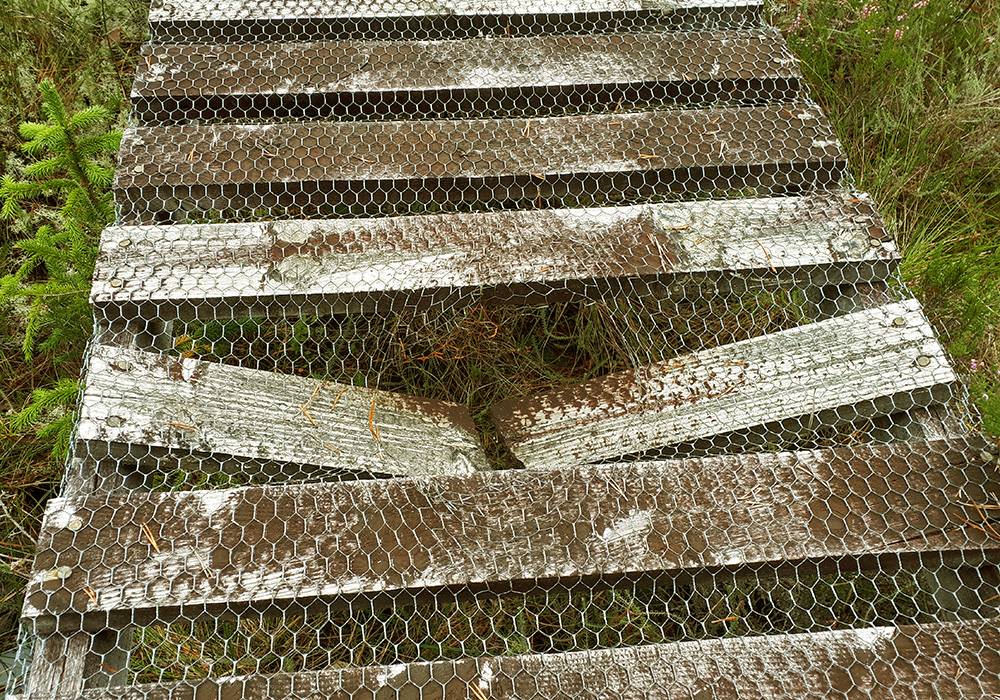
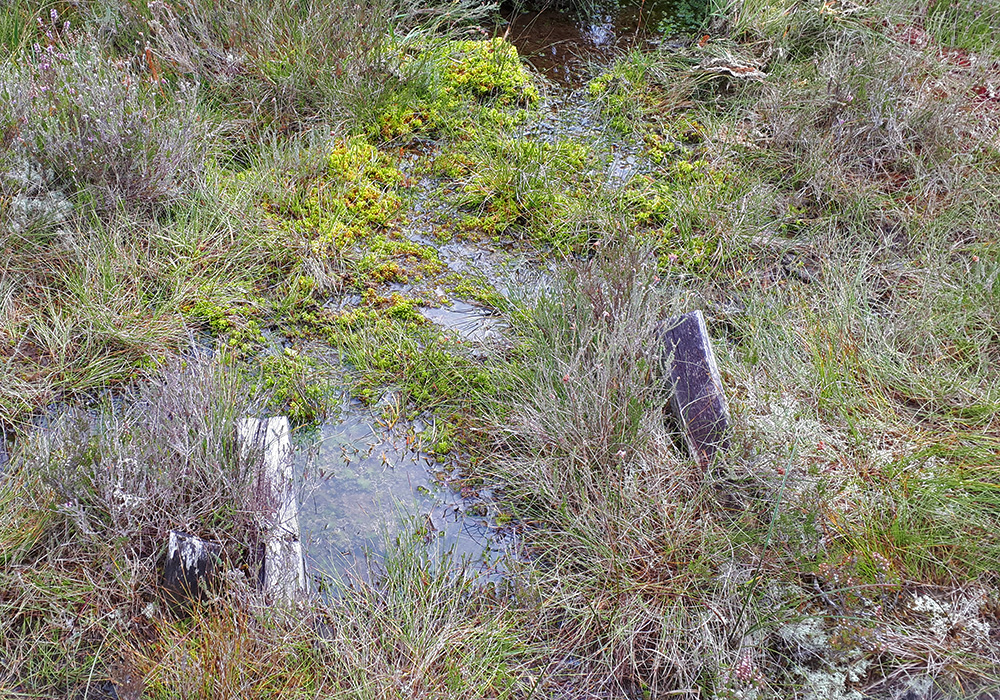

With fading infrastructure, there is always work that can be done to help with the passing. On this occasion, I carefully remove and bag up all of the remaining barrier rope. Made of polypropylene, this cordage will slowly disintegrate into a plastic dust. To install it—and leave it abandoned—in a nature-rich wetland is an act of gross irresponsibility.
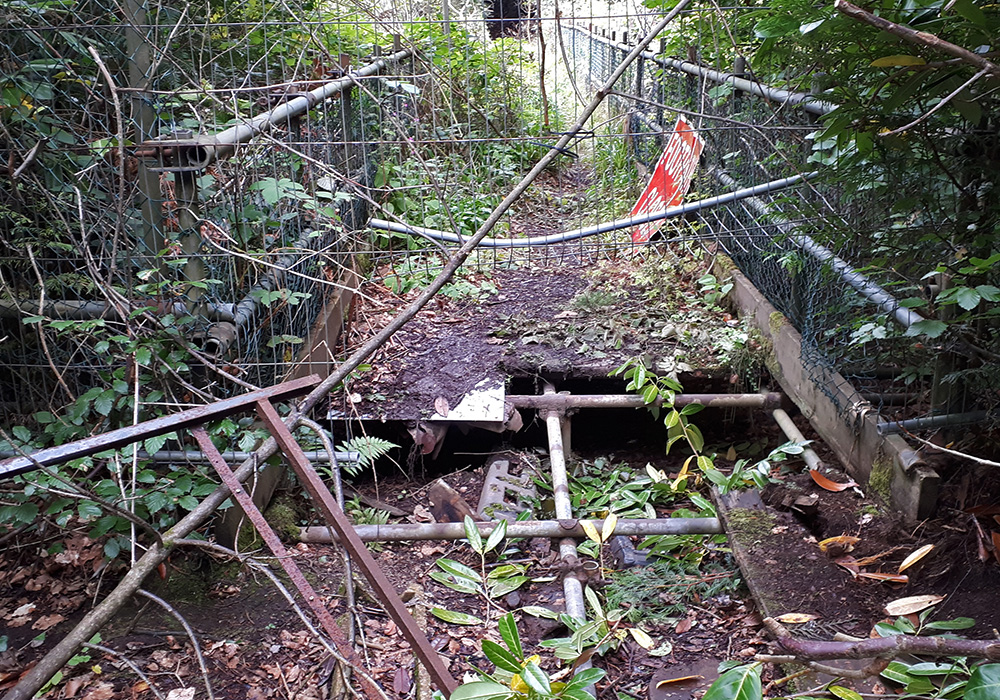
At length, I leave the boardwalk and descend to the woodland’s edge. I am nearing the end of my walk, and it is time to locate a crossing by which I can pass back over the river, downstream from the dipper’s territory and the tourist-luring cascade. The latest edition of the Ordnance Survey map shows two fully functional road bridges near to where I am. While the lower of the two has been accurately depicted, giving me an easy passage of return, all that remains of the upper is another dilapidated pathway. This, however, is one that I will have to save for another time.
Share your thoughts with the author
This message will be emailed to the author (and will not be published).


 Earth Tongues