



There’s nothing under Heaven so blue
That’s fairly worth the travelling to— Robert Louis Stevenson in ‘The Silverado Squatters’
Three summers ago, I typed the words “most probably correct” in closing an Earth Tongues piece titled Smiles and scowles: Puzzles in the Forest. At that point, I felt that I had written all that I was ever going to on the subject of tourists experiencing curious English woodlands. But a recent encounter with an Italian couple, on a misty July morning, has set me penning this unexpected sequel.
The new story finds its beginning one evening nine years ago, when I was on a residential forestry course in North Wales. I cannot recall all the drinks that had lubricated the socializing of the night in question—retsina, probably, and perhaps also a vodka made with Douglas fir—but the look of utter sincerity on the face of one conversational partner has stayed with me through all the intervening seasons.
“You have to visit this wood,” he said—or words to that effect. Then he added, “It’s like no other place on Earth,” with an authority suggesting first-hand knowledge of all Gaia’s gardens. It would be an understatement to say that the man had sown the seed for a future trip. Instead, he had planted a vigorous sapling, with wrap-around tree guard and supporting stake.
In the years that followed, water and light came in large doses from others who knew of this wooded place: a half-mile chain of oak-dominated copses in the windy and barren heart of Dartmoor National Park. A visit of my own seemed to be in the stars. But another force started to exert a pull, and that was a nascent personal philosophy that the best way to love a distant—or semi-distant—place might be to leave it alone (Gray, 2018; Gray and Whyte, 2024).
I wanted this woodland to be one that I resisted; and there was no shortage of writing on the place to sate my hunger for ex situ (i.e. in-armchair) understanding. Most notably, perhaps, John Fowles rejoiced at the wood’s uniqueness while describing his own visit, in The Tree (Fowles, 2010: 84):
We go down to the uppermost brink. Names, science, history… not even the most adamantly down-to-earth botanist thinks of species and ecologies when he or she first stands at [the wood]. It is too strange for that. The normal full-grown height of the common oak is thirty to forty metres. Here the very largest, and even though they are centuries old, rarely top five metres.
As no writer worth their gall ink could fail to note, it is not just the stunted height of the oaks in their challenging environment that is extraordinary, but their form too (ibid: 84):
Their dark branches grow to an extraordinary extent laterally; are endlessly angled, twisted, raked, interlocked, and reach quite as much downward as upwards.
And not only their height and form, but also the luxuriant assemblage of epiphytes that they support (ibid: 85):
It is a paradoxically tropical quality, for every lateral branch, fork, saddle of these aged dwarfs is densely clothed in other plants—not just the tough little polypodies of most deciduous woodlands, but large, elegantly pluming male ferns; whortleberry beds, grasses, huge cushions of moss and festoons of lichen.
Through the passages above, among others, Fowles had transported me to this idiosyncratic and isolated locale. But then, on page 90, he undid all this useful work with the following observation on the woodland:
Its greatest value to us is that it cannot be reproduced, that this being can be apprehended only by other present being, only by the living senses and consciousness. All experience of it through surrogate and replica, though selected image, gardened word, through other eyes and minds, betrays or banishes its reality.
My resolve was upended. And, thus, one grey morning last month, my wife and I found ourselves on a bus that would stop at the trailhead for the famed and sacred wood. Over breakfast that day, our host on Dartmoor had told us of metal fencing being erected around the trees during the pandemic to offer armour against the spike in visitor numbers. Staring through the windscreen and into the light mist ahead—the bus’s wipers making a periodic passage across the glass—I hoped for two things. The first, that the fencing had been removed. The second—in what is an eternally recurring wish, although I knew it here to be unrealistic—that the trail would be quiet.
The bus that we had caught was the earlier of the two daily options heading west across the national park. These services ran only fifteen minutes apart, which—in an eccentricity of scheduling that was to be the first puzzle on the Moor—meant that there was a busless gap each day of twenty-three and three-quarter hours. Yet, I was grateful that there was any kind of service across the high country of Dartmoor. (For one thing, some of the roads here are sufficiently narrow to trigger spontaneous rounds of applause among the passengers on their successful negotiation—a phenomenon that I have not experienced on any of my countless bus journeys elsewhere.)
This particular southern English landscape, which has been a national park since 1951 and a site of human habitation for at least 10,000 years before that, boasts granite-studded moorland for its core and a broad fringe of farmland and wooded valleys. It is renowned for its wild and remote feel, in a part of the world where such qualities are rare, as well as a vast wealth of surviving prehistoric relics that includes stone circles and burial chambers. Arthur Conan Doyle is one of several authors to have found it irresistible as a setting, sending Dr Watson and Sherlock Holmes out onto Dartmoor’s bleak hills and mires in The Hound of the Baskervilles.

As reflected in Conan Doyle’s dialogue, this wild place is known to locals simply as ‘the Moor’, in the way that the Forest of Dean—described in the aforementioned precursor to the present tale—is ‘the Forest’. And, like in that other site of rich socio-ecological history, one finds, on Dartmoor, that their brain is teased at every turn.
On a different day during our stay, to give an example, my wife and I were puzzled by a series of granite marker-posts that lined our ridge-hugging path. Each stone was inscribed with the characters ‘PCWW 1917’—an acronym and a number whose meanings we struggled to unpick. (“Parish Council of West Wherever,” I suggested feebly at one point.) An important clue to which I had failed to give sufficient attention was the markers’ positioning along a line of high ground. The solution—I later learned—related to catchments, with the first ‘W’ standing for ‘Water’. To give a little more detail: the posts ringed the watershed for a reservoir below, and a conveyance of this land had been made to Plymouth Corporation Water Works in 1917.
I watched the wipers sweep across the windscreen for a final time as we stepped down off the bus and into a small car park used by visitors to the oak wood. Surprisingly, for this age of mass exploration, there was only one vehicle stationed there; and, thus, my hopes for a relatively undisturbed walk no longer seemed so quixotic. Equally unexpected was the vehicle’s number plate, for it bore a registration from the far-off land of Italy. How nature-oriented tourism had so badly failed in disentangling itself from the carbon profligacy of our times struck me as just one more enigma.
The trail—starting as a vehicle track and then narrowing to a well-walked footpath—led us up the broad, open gulley of the West Dart River. At first, our treed destination was hidden by the land’s topography, but its mist-draped canopy slowly came into view as a dark form in the grey distance. The moorland’s underlying soundscape of wind and water was enriched by the many birds who moved noisily about us: some shifting between perches atop furze bushes; others zipping up or down the valley. A small group of goldfinches, in particular, brought delightful splashes of vibrancy to our ears and eyes. All the while, the trail lacked any sign of human presence but our own. I could not, in that moment, conceive of a more soul-stirring approach to this venerated wood.
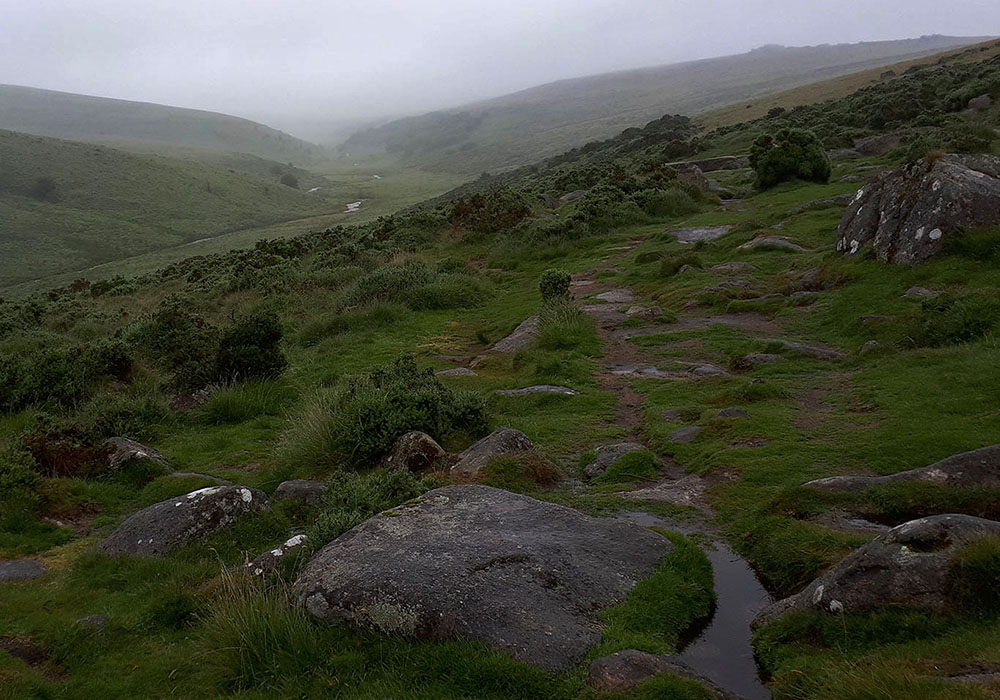
As always seems to happen when I am nearing someone or something that I desperately want to see—according to my wife, at least—my pace quickened unconsciously; and we had soon covered the mile that separated road and woodland edge. The barriers had been removed and the interior’s fragile and unique ecology was protected, instead, by a small number of signs asking visitors to keep to the wood’s perimeter in enjoying the place.
My own experience of witnessing this extraordinary community of stunted oaks and their floral kin, all hugging a ground layer of rocks and boulders that is known locally as clitter, is not something that I will recount here. I will note simply that a true sense of awe quickly welled up inside me, and that this upsurge precipitated two polarized feelings: an extreme privilege to be able to be present in such a place and a gnawing guilt about not having resisted its lure.
After some time, my wife and I turned on our heels and set off back towards the road. There was another bus to catch, and—before that—an old inn to which we wanted to give our custom. During the first part of the return walk, I pondered one of Dartmoor’s greatest mysteries: Why, in this valley of so few trees, was the wood we had visited there at all?
I was reasonably well versed in the competing theories, from my reading of books such as Ian Mercer’s Dartmoor (Mercer, 2009). Two different ideas centred on the clitter: Had this made clearance by humans too arduous? Or had it discouraged the browsing of seedlings by other mammals? Another hypothesis leant on a possible ceremonial significance. Then there were suggestions that the trees might not be a remnant of the wildwood: Had they been planted for hunting cover, or even as a landscaping whim?
The breadth of this range of possible provenances only added to the mystique of the woodland, and I was satisfied to leave the quandary unsolved. Soon, though, another puzzle presented itself. A pair of walkers, a woman and a man in their thirties, were heading back up to the main track through the valley after taking a detour to study the river in its trough. Our routes coincided—and the mist turned into a rain of distinct drops— just as they rejoined the path. We traded pleasantries and it quickly became evident that they were the owners of the Italian car, and that they were on their way back, having already visited the oak wood. They were the first people whom my wife and I had encountered since our own experience, and I was eager to enjoy what I presumed would be a shared feeling of reverence.
Astonishingly, the Italians were thoroughly disappointed by their day so far. They felt that the one-mile walk from the car park had been far too long. (I do not think that this related to some physical disability, as they had been happy to make their detour to the river, but I offer my apologies if it did.) Furthermore, the woodland, for them, was too small, and the oaks were far too short! “Trees should be taller,” the lady opined. At least she did not complain about the plentitude of epiphytic growth preventing them from seeing the bark.
Our conversation, and the rain, continued. Apparently, the Italians’ trip had been inspired by seeing a photo in an online list of must-visit places rather than any form of more detailed research. My attempt to suggest why the trees were worthy of admiration in their own way did not hit its mark. Whether there was a language barrier here, I could not say; the tourists simply sighed at their misfortune. Yet, they were not about to give up. “Do you know Puzzle Wood?” the lady asked, as if this were in the next valley and not a 130-mile drive away. This, it seemed, was their target for the afternoon.
“I do,” came my response. (Since this was the focus of my piece on the Forest of Dean mentioned above, it is a place on which I could describe myself as a ‘published authority’, although, of course, I did not.)
“Are the trees bigger there?”
“They are,” I had to concede.
“And can we park our car closer?”
“You can.” (I chose not to suggest that they look out for the receptacle in the car park that looks like the head of a stormtrooper.)
Once back at the road, my wife and I crossed the carriageway and headed for the old inn. My pace, apparently, had quickened once more. Stepping inside, we eyed up, in one corner, a pair of comfy chairs on which we would be able to hang our waterproofs—this establishment being relaxed about such things—and discuss the morning’s events over a drink.
The two tourists dominated our conversation. Their honesty, we reflected, was something that had to be admired. And there must have been a part of them that was missing the grand forests of the Italian peninsula. In turn, we were reminded of a young German lady whom we had met a few years earlier in the Scottish Highlands. She had come across in a diesel-burning campervan with a great sense of anticipation, but she had been entirely underwhelmed by the scenery and wished that she had gone on holiday in her homeland instead.
Clearly, not every trip we take is going to astound us or every place we visit be enchanting. Moreover, I do not believe that putting a great distance between oneself and one’s home, by plane or by car or by other means, dramatically increases the chance of finding somewhere or something special. (It does, however, guarantee significant carbon emissions, to one degree or another.) The Italians might have been happier in the woodlands of Abruzzo. The German lady would probably have preferred, say, Harz National Park. And—while I did not experience the disappointments of these continental travellers—I could also have stayed closer to home. There are less-distant places that might be similarly rich in puzzles for me, if I only explored them.
Let’s ignore the internet’s must-see lists and any retsina-fuelled advice. We can all travel from our armchairs. And we can all learn to love local.
References
Fowles J (2010) The Tree. Ecco Press, New York, NY, USA.
Gray J (2018) Armchair ecotourism: A tribute to Edward Abbey. The Ecological Citizen 1(2): 145–7. Available here (accessed August 2024).
Gray J and Whyte I (2024) Respecting nonhuman life: The guide for a better pathway in outdoor recreation. In: Gray J and Crist E, eds. Cohabiting Earth: Seeking a bright future for all life. SUNY Press, Albany, NY, USA: 193–206.
Mercer I (2009) Dartmoor (New Naturalist #111). Collins, London.
Share your thoughts with the author
This message will be emailed to the author (and will not be published).


 Earth Tongues