


I never had the opportunity to meet the venerable Sycamore Gap tree before it fell, leaving an emptiness befitting its name in the hearts of the British nation. Like most, this senseless act of cruelty dismayed me, yet there was another facet to my anger and confusion: I feared the hand of environmental activists. Would anyone seriously take a chainsaw to the living body of a much-beloved tree to highlight the plight of nature? It appears the criminals held no affiliation with today’s prominent activist groups, but I believe my concern was warranted since protests have taken a counterproductive turn in recent years.

I confess my temperament has never been given to disorder, much less deliberate vandalism. From the day Extinction Rebellion (XR) entered the scene dancing as they dug up the grounds of Trinity College I’ve found activists’ reasoning tenuous and their methods juvenile, especially when separate social causes are mixed haphazardly together (as expected in these days of intersectional identity politics). Spraying the facades of banks makes more sense, but performative defacement is unattractive when one considers how many scientists, philosophers and artists are working diligently in the background to find practical solutions and help us think in more nuanced and life-affirming ways. But let me be clear, I’m not seeking to delegitimise non-performative protests intent on halting Earth-destroying operations like logging and factory farming. I commend activists who heroically target the root causes of planetary decline by more direct means, but this is rare.
Protestors have overwhelmingly asserted themselves as a public nuisance. As I write, Just Stop Oil (JSO) are spearheading a new movement to disrupt airports as part of the ‘Oil Kills’ international rebellion. This comes on the back of their most notorious mission, that of occupying motorways, which has racked up staggering costs and stopped innocent people getting to hospitals and funerals—people who likely shared concerns about our planet’s wellbeing until activists decided to hog the roads. Frankly, it irks me that few of these actors seem to practice what they preach since the clothes they wear, the vehicles they drive and the devices they use to organise and get to protests inevitably make use of oil in some form—including the glue with which they attach themselves to paintings. Here we reach the heights of absurdity.
I believe that created things have the power to move us far beyond any ephemeral act of disruption. JSO, fiercer and less reasonable than XR, don’t agree since they’ve plastered scenes of ecological degradation over John Constable’s The Hay Wain (1821), thrown soup onto Van Gogh’s Sunflowers (1888) and broken the glass casing containing Diego Velázquez’s Rokeby Venus (1647-51). Of these examples—and there are many more—that of The Hay Wain is the least egregious to me as it’s an attempt to make us aware of nature’s destruction. And yet I find it ultimately ineffectual, even simpleminded, since contemplation of art can awaken us to a wider world and direct us in more ethical ways. But, as Patrick Curry attests, the enchantment of art only ‘thrives in the midst of simplicity, humility, and purity of spirit, just as sound requires silence to be heard, and light to shine needs darkness’.1 Enchanting experiences are already few and far between in this increasingly noisy and heated world. What, then, are we to make of activists who cause hopeful visitors to be ushered out of viewing rooms and increase the likelihood of artworks being removed from public display altogether?

Philosopher Michel Serres theorised that human-caused pollution arose out of the territorial marking behaviours of nonhuman animals. However, we’ve extended this tendency to appropriate the Earth on a global scale through the proliferation of residues and emissions and the contamination of images and letters. Speaking on the ills of advertising in particular, Serres opined that these ‘low and facile signs clog up the landscape, which itself is more difficult, discreet, and often dying because unseen by any saving perception’.2 Activists similarly sever our connections to mind-broadening works when they obscure or damage them and when they shout their slogans and doomsday prophecies at the top of their lungs. Some may truly be intruding on behalf of nature, but I don’t think it’s far-fetched to suggest that many of the younger smashers and sprayers dominate these shared spaces of meaning to advertise their adherence to the in-group. In this digital age it’s all too easy to succumb to dreams of virality and the trappings of activism-as-lifestyle.
Protestors and their supporters often contend that anyone who’s more angered by the desecration of a painting than they are over the reasons for the protest should think long and hard about what that says about them on a personal level. But who among us isn’t aware of ecological devastation and climate breakdown? Even if some prefer to bury their heads in the sand, that doesn’t justify continued assaults on art. Also, I fail to see why inept and greedy authorities should be touched by these performances if regular people who already care are outraged by them. Most worrying is the claim that the consequences of these demonstrations are trivial compared to the impending apocalypse. But isn’t it twisted to take away what’s left of the good in this world as a comment on the loss of the good?
We need instead to cultivate the saving perception. This rests on the adoption of a non-reactionary sense of conservative gratitude for what we already have and what has come before us, including great artistic achievements. Unfortunately, we don’t tend to value what’s been made in our society, nor do we have any strong impulse to create. According to Douglas Murray, the desire to destroy is greater in ‘green cultists’ because they’ve been fed on a diet of ‘nihilism and anti-human attitudes that are pumped out at them’.3 While I shrink at such inflammatory language, protestors bring these labels upon themselves when through their deeds care for nature is all the more easily conflated with zealotry and misanthropy. It’s hard to deny that there’s a paucity of positivity in the world, which is why Murray pleads for us to ‘live lives of hope’ instead of always giving into despair and tearing things down.4 The first step, he suggests, is in deciding whether we are ‘the sort of person who burns or the one who saves’.5 That line, echoing Serres, has stuck with me much longer than any of the activists’ messages.
Why do protestors choose burning over saving? Mary Harrington has attempted to make sense of their actions:
To the extent that the emergence of fossil-fuel-intensive modern society is inextricable from the broader cultural arc that produced these artworks, it’s perhaps understandable that a movement that wants to end fossil fuel use would aim its energies at the wider worldview that sees that use as indispensable—including its artistic legacy.6
Protestors may therefore see Western culture itself as the problem. By employing ‘anti-cultural interventions,’ they’re playing into the current socio-political mania forcing us to exist in a state of constant revolution.7 At the extremes this involves feeling deeply ill at ease in one’s own society, hating its very foundations. The West certainly has its demons, not least among them anti-ecological thought and practice, but it’s a weak association on the part of the protestors since so many masterpieces extol nature. And I dare say that our civilisation has given us so much and is by no means as evil as many now deem it to be.
Alas, in modernity we scorn everything old and stable. As Tim Stanley has lamented, we in the West find ourselves following ‘a tradition that is anti-tradition,’ always feeling that something must be done to further emancipate ourselves and achieve progress.8 The consequence of this worldview is that anything can be justified, even attacks on art. And yet the strongest case for safeguarding art lies precisely in seeing nature and culture as inextricable, each recursively defining the other. Ewan Morrison puts it best by arguing that those who ‘set the idea of a corrupt civilisation that values art against the ecological survival of the species […] are presenting a false dichotomy because art is part of our human nature’.9 That’s why it’s important to understand that every act of damage and disruption, however small, weakens the frame that holds us up and provides us with windows that look onto more positive realities.
Sadly, it’s not only paintings that activists threaten. Museum exhibits have also seen disruptive activities, such as when two health professionals covered a titanosaur replica in paint at London’s Natural History Museum. Call it sentimental (a bad word these days), but I so firmly believe in enriching encounters with the other that it brings me almost to tears to think on this selfish act stopping a child from experiencing the awe of the old and growing up to be a palaeontologist or a natural history painter. And what did sprinkling a dinosaur model achieve other than garnering fifteen minutes of fame? The impact on a young mind has the potential to last a lifetime.
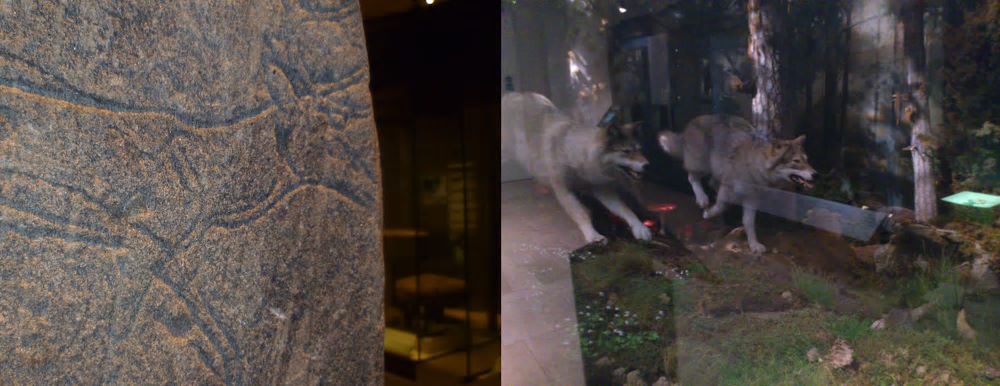
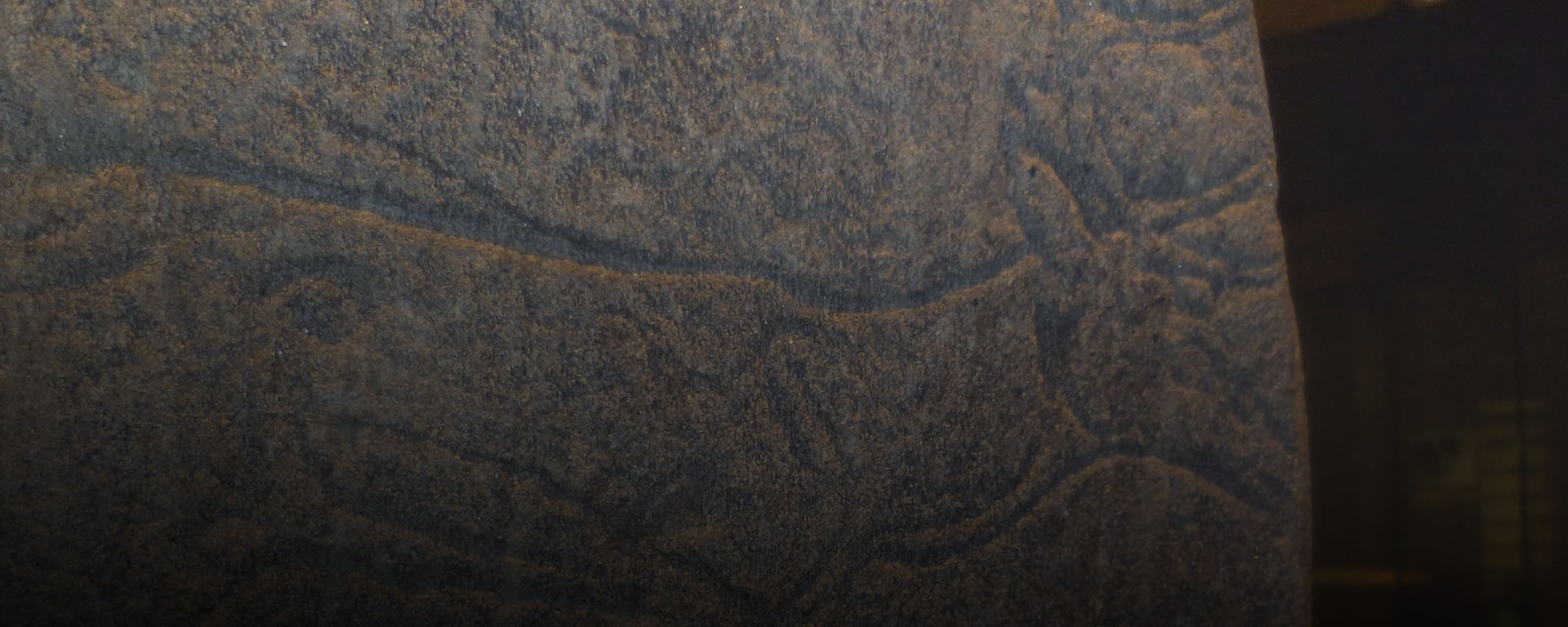
I’ve often imagined how I’d react were I to witness the endangerment of a favourite work of art or historical artefact first-hand. Invariably, scenarios set in the National Museum of Scotland spring to mind. This museum is important to me because it symbolises a period when my interest in prehistory melded into a love of natural history. In particular, I’ll always be indebted to one Pictish carving of a deer, which came to life for me. I’m thinking also of a lush Mesolithic diorama and its depiction of the ancient oakwoods of Scotland, wolves and all. Peering into that exhibit in a dark and quiet part of the museum, I witnessed the power of free and wild beings we’ve since so shamefully lost.
Encountering artefacts and exhibits in my teens inspired me to help people become aware of our growing disconnect from nature. I did this not by destroying in defence of the planet but through small co-operative acts of creation and community building. For example, more than a decade ago I started a website project (‘Oakenwise: remember the men from whom you are descended’), which took writing on topics ranging from wilderness skills to polytheistic religion from people around the world. The treasures I discovered stayed with me as I volunteered at nature reserves and special places of learning like Butser Ancient Farm. They also granted me the persistence to study wildlife ecology over five years and, after returning to the humanities, aided in the writing of a thesis on Earth-centred sacrality. Considering all of these positive outcomes, I can’t conceive of a scenario in which I’d cheer on people seeking to deny others the same transformative journeys.
It’s one thing to jeopardise someone’s relationship to a particular painting or antique object in a secure space, but it’s another to take this attitude into the built environment since architecture and monuments set in public squares serve as definitive expressions of how we understand our relationship to the Earth. Living in and seeing these structures every day deeply affects our mental health. Thus, in a world paved over with concrete and blocked out by skyscrapers, and in which the notion of beauty itself is mistrusted or even despised by the cynical art market and practitioners of the doctrine of shock and ugliness, we must cherish every inch of beauty.
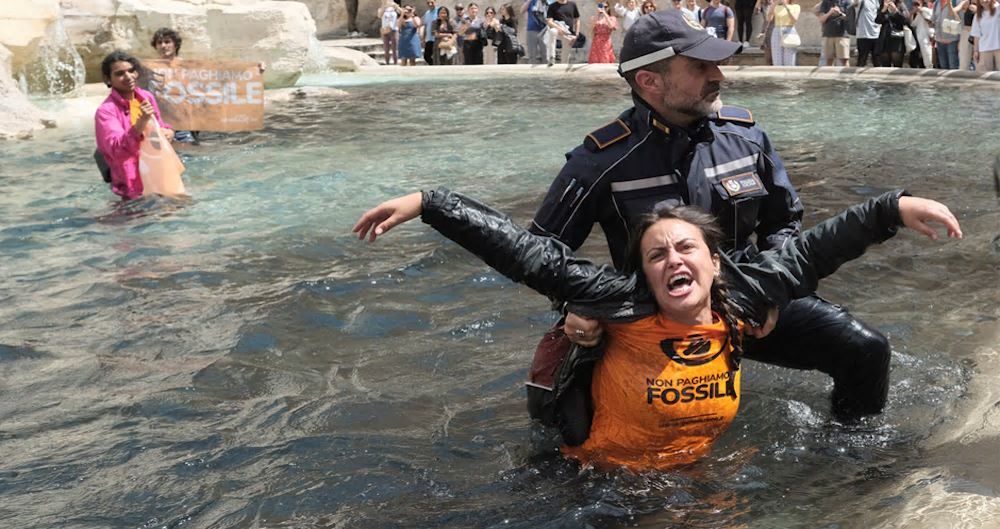
Our slice of time is regrettably defined, however, by the almost complete abandonment of decoration and adornment, especially the use of natural motifs and traditional scenes inspired by mythology. This is why vandalism of monuments such as the Trevi Fountain by Ultima Generazione, who poured diluted charcoal into the fountain, are so troublesome. This stunt infuriated Italian nationals and art history lovers across the globe and wasted thousands of litres of water in the clean-up process. Looking at photos of the protestors being escorted away, so flustered and full to bursting with the ire of Mars (aptly), I couldn’t help but reflect on my own visit to the fountain some years prior. Not once did ruination enter my thoughts. On the contrary, that masterful Baroque sculptural panoply humbled me and connected me to ideals that have bound a people together. Expanding further outward still, as I gazed on the countenance of Oceanus, the world-encircling river and origin of all the Earth’s waters, my awareness of the danger to the planet as a whole was refreshed.
But it appears some activists aren’t concerned with the vital tethering of heritage. Recently, JSO proved their madness when they set upon Stonehenge, which, being close to home, hit hard. For Brendan O’Neill, this ‘savagery masquerading as protest’ showed a ‘horrific disregard for the history and people of this nation’.10 I couldn’t agree more. By spraying those incomparable sarsen stones, upon which grow enigmatic markings and rare lichen assemblages, the group threatened to erase part of Britain’s story. It’s simply not acceptable to brush away this mischief by pointing to the fact that there wasn’t any significant damage. That it happened is preposterous enough. Most disturbingly of all, the spraying amounted to an attack on a religious site for neopagans and other Earth-centred creeds. Stonehenge is a place of worship no different than any Christian cathedral or Muslim mosque.
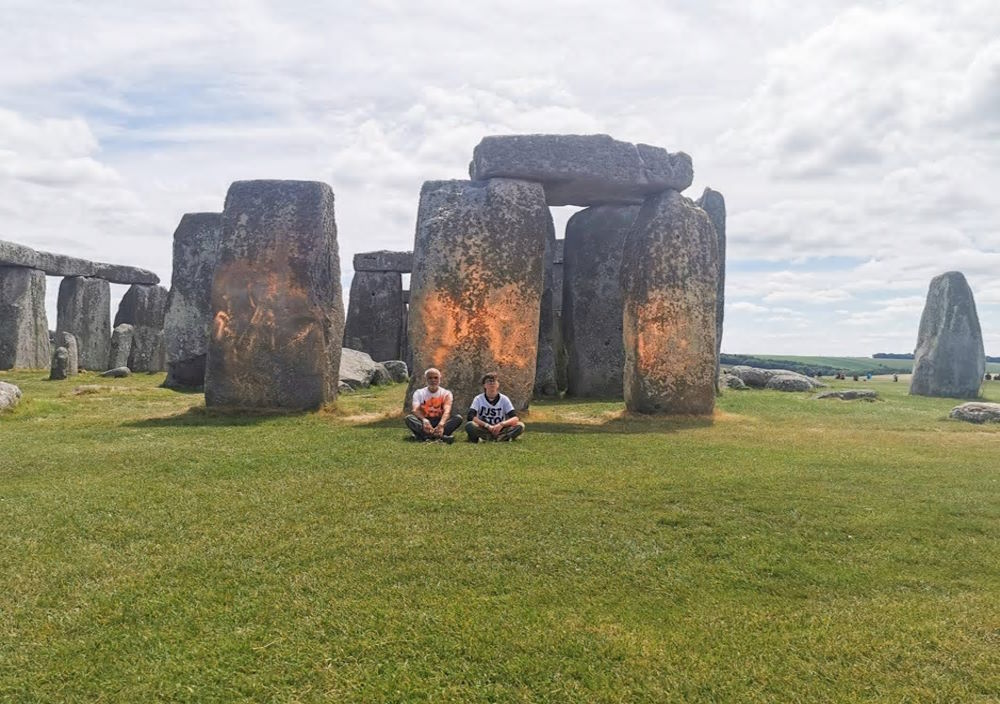
In a message explaining why they singled out Stonehenge, one spokesperson for JSO proclaimed, ‘Stone circles can be found in every part of Europe, showing how we’ve always cooperated across vast distances – we’re building on that legacy’.11 I find something sinister in this response. Is it a call to vandalise more stones? Even if it isn’t, the irony is truly extraordinary. No, dear protestor, you’re not building on anything, certainly not any European legacy.
I plead with destructive activists to reconsider their methods. If you truly care, put down your hammers and spray cans and save what remains to us. Save by looking.
Footnotes
- Patrick Curry, Art and Enchantment: How Wonder Works (Abingdon: Routledge, 2023), p. 25. ↩︎
- Michel Serres, Malfeasance: Appropriation Through Pollution? (Standford: Standford University Press, 2010), p. 51. ↩︎
- Douglas Murray, ‘Are you a creative or a destructive?’, The Spectator, 11 November 2023. <https://www.spectator.co.uk/article/are-you-a-creative-or-a-destructive/> [accessed 11 December 2024]. ↩︎
- Ibid. ↩︎
- Ibid. ↩︎
- Mary Harrington, ‘Anti-culture protestors vandalise the Trevi Fountain’, UnHerd, 22 May 2023. <https://unherd.com/newsroom/anti-culture-protestors-vandalise-the-trevi-fountain/> [accessed 11 December 2024]. ↩︎
- Ibid. ↩︎
- Tim Stanley, Whatever Happened to Tradition? (London: Bloomsbury Continuum, 2023), p. 34. ↩︎
- Ewan Morrison,’Carnivals Come Cheap – Eco-Activists and the Attacks on Art’, Untopia, 7 August 2024. <https://ewanmorrison.substack.com/p/carnivals-come-cheap> [accessed 11 December 2024]. ↩︎
- Brendan O’Neill, ‘Just Stop Oil’s Stonehenge attack is unforgivable’, The Spectator, 20 June 2024. <https://www.spectator.co.uk/article/just-stop-oils-stonehenge-attack-is-unforgivable/> [accessed 11 December 2024]. ↩︎
- Just Stop Oil, ‘It’s Time for Megalithic Action: Just Stop Oil Decorate Stonehenge’, Just Stop Oil, 19 June 2024, https://juststopoil.org/2024/06/19/its-time-for-megalithic-action-just-stop-oil-decorate-stonehenge/ [accessed 11 December 2024]. ↩︎
Bibliography
Curry, Patrick, Art and Enchantment: How Wonder Works (Abingdon: Routledge, 2023)
Harrington, Mary, ‘Anti-culture protestors vandalise the Trevi Fountain’, UnHerd, 22 May 2023. <https://unherd.com/newsroom/anti-culture-protestors-vandalise-the-trevi-fountain/> [accessed 11 December 2024]
Just Stop Oil, ‘It’s time for megalithic action!- Just Stop Oil decorate Stonehenge’, Just Stop Oil, 19 June 2024. <https://juststopoil.org/2024/06/19/its-time-for-megalithic-action-just-stop-oil-decorate-stonehenge/> [accessed 11 December 2024]
Morrison, Ewan, ‘Carnivals Come Cheap – Eco-Activists and the Attacks on Art’, Untopia, 7 August 2024. <https://ewanmorrison.substack.com/p/carnivals-come-cheap> [accessed 11 December 2024]
Murray, Douglas, ‘Are you a creative or a destructive?’, The Spectator, 11 November 2023. <https://www.spectator.co.uk/article/are-you-a-creative-or-a-destructive/> [accessed 11 December 2024]
O’Neill, Brendan, ‘Just Stop Oil’s Stonehenge attack is unforgivable’, The Spectator, 20 June 2024. <https://www.spectator.co.uk/article/just-stop-oils-stonehenge-attack-is-unforgivable/> [accessed 11 December 2024]
Serres, Michel, Malfeasance: Appropriation Through Pollution? (Stanford: Stanford University Press, 2010)
Stanley, Tim, Whatever Happened to Tradition? (London: Bloomsbury Continuum, 2021)
Share your thoughts with the author
This message will be emailed to the author (and will not be published).


 Earth Tongues
One thought on “Just Save Perception”
Comments are closed.