


Mutton chop whiskers. Sweeping grey hair. A slightly-too-large dark jacket. The appearance of Henry Walter Bates, as depicted in a biographical sketch published shortly after his death in February 1892, was very much that of a distinguished Victorian male scientist. And he had indisputably earned his stripes.
The contribution to science for which Bates is best known—as told in that sketch—arose from a trip he took to the Amazon region, where his chief purpose was the collection of insects. After sailing out from England in 1848 with his friend Alfred Russell Wallace, he returned eleven years later having found 8000 species new to Western knowledge. The long sojourn was “detrimental to his constitution,” however, and he returned “a wreck of his former self.”
As I said, Bates had earned his stripes. The same cannot be said, though, for the organisms at the centre of his major scientific contribution. Based on his observations of the Amazonian fauna, especially heliconian butterflies, he described in detail the kind of imitation in which a harmless insect has evolved a similar appearance to a harmful one, “to protect the otherwise defenceless insect by deceiving insectivorous animals.” Today, this form of deception, which is common in insects but also more widely known, is something that we call Batesian mimicry.
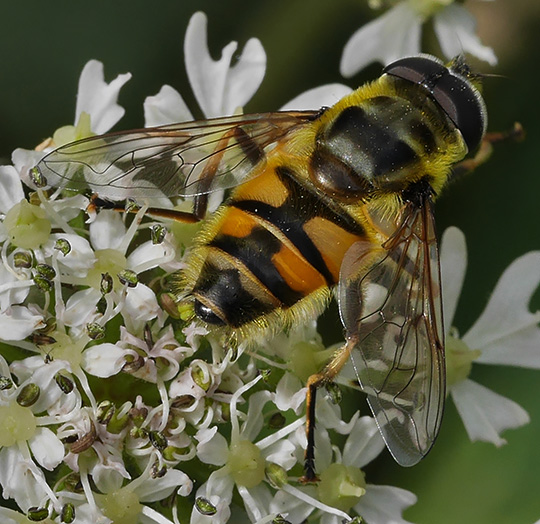
Examples are not hard to find. On a camping trip that my wife and I took during the most recent northern summer, we pitched our tent on a warm afternoon near a woodland edge rich in flowering bramble. The bounty of readily available pollen and nectar was servicing a multitude of flying insects, many of them decorated with the yellow-and-black scheme so deeply associated with danger. Mixed up with the social wasps and the other honest signallers, however, were various hoverflies with similar coloration but no underpinning defences. Their markings were deceptive, in a way suggestive of Batesian mimicry.
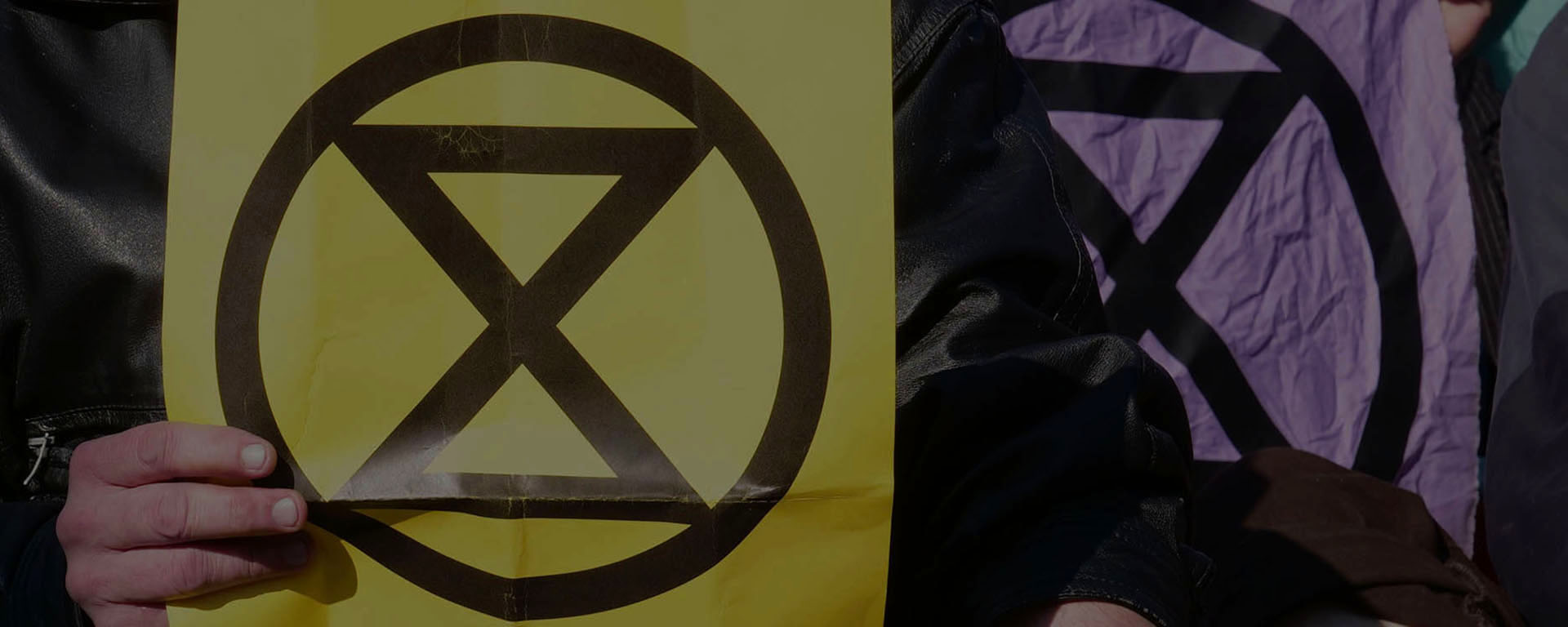
Later, after a stove-cooked dinner of mushrooms and other morsels that we had gathered from the shelves of a local shop, I was cleaning my teeth in the no-frills toilet block of this deliberately basic campsite. As I brushed, I noticed a badge on the T-shirt of a fellow performer of end-of-day ablutions. The man’s pin bore the encircled hourglass that has been adopted as the symbol for Extinction Rebellion, and, being a rather passionate objector to species loss myself, I was eager to strike up a conversation. But before I had completed the extra-careful cleaning of incisors necessitated by gum recession and prepared my mouth for verbal communication, the man had exited the washroom. Outside, in the darkness, his swaying torch beam evidenced a speed of tent-bound movement that I was not prepared to match.
Happily, I saw the man again early the next day, near the toilet block once more, and it was actually he who initiated the conversation. With his right hand held up to indicate the plastic bag that it clutched—large, clear, and bulging with tin cans, plastic bottles, Tetra Pak cartons, glass jars, and other debris—he asked: “Do you know where I can throw this?”
“Awesome, you’ve done a litter-pick,” I responded, thinking it implausible that a badge-wearing opponent of extinction would be discarding his own waste without any attempt at recycling. This reasoning followed from a contention that for anyone living in a country, such as Britain, with a municipal kerb-side collection of repurposable materials, taking advantage of it is about as entry-level as environmentalism gets.
“No, this is just our rubbish,” he continued. A few seconds later, the question of who the word ‘our’ referred to got its answer in the form of a sporty red car with heads stuck out of the front and rear windows on the driver’s side. And from these two heads came coordinated cries: “Come on! Let’s go!”
The badge-wearer looked at me with pleading eyes. I surmised that he wanted me to take the rubbish for him. Deciding that I was not going to be manipulated in this way, I tried to at least be helpful: “I think there’s a sign saying that you have to take your rubbish with you. They say it’s so you can recycle as much as you can back at home. You know, in your own bins.”
The gaze that had so recently been like a puppy dog’s now resembled that of a deer caught in the proverbial headlights; soon after, I took my leave. Turning back, once I was thirty or forty yards distant from where the conversation had unfolded, I saw that the large bag of rubbish had been abandoned by the toilets and that the red car was bouncing along towards the exit gate. The Batesian rebel had fled the scene.
The man whom I met on the campsite offered me the most pronounced example of a phenomenon that I have, in recent years, been witnessing with increasing frequency. I’ve seen it in the woman with a “Save the Earth” tote bag in her left hand and a single-use coffee cup—plastic lined and lidded—in her right. And in the man on the green committee at work who boasted of his recycling efforts and later flicked a cigarette butt into the drain. And also, of course, in all those celebrities who talk of environmentalism, between flights in their private jets.
Yes, life is complex, and all of us will make good and bad choices. But it is really not asking much of someone who boasts of green virtues to get a reusable cup, or to find a bin for their cigarette end, or to forego those nauseatingly luxurious flights. As far as ‘sacrifices’ go, these are among the lowest-hanging of fruits. (They are certainly trivial in comparison with the recently publicized choice made by the 17-year-old Innes FitzGerald, English Schools cross-country champion, to decline a place at the world championship in Australia because of her concerns about the impact of travel.)
Furthermore, I believe that we are living during a period in Western history when being green is evolving from a minority interest to a broadly expected social virtue. If we are going to avoid inflicting the worst kinds of damage on the Earth’s living systems over the coming decades, it is crucial that this cultural transition—if I am correct that it is happening at all—be securely undergirded by genuinely positive behaviours. The alternative, in which Earth-kind behaviours are seen as fashionable enough to proclaim but too inconvenient to practise, may well spell doom for most of life. The same requirement for fidelity applies, of course, not just at the level of the individual but at that of the institution too. However, the relative importance of individually chosen and institutionally driven actions is not something that I will cover here (other than noting that one especially insightful contribution, by Luke Plotica, can be found here).
It’s time, then, I say, for all of us to stop pretending and make the changes that we know we need to. And if we’re going to go beyond practising good behaviours to speak of them too, I feel that we need to be like the social wasps and earn our stripes.
Share your thoughts with the author
This message will be emailed to the author (and will not be published).
Read ‘Beware the Batesian rebel’, by Joe Gray, on the #EarthTongues blog
Tweet


 Earth Tongues