


This post is part of a series titled ‘Beneath the birch and pine’, whose uniting theme—beyond the writer’s nature-centred standpoint—is the inspiration that each piece finds in some aspect of life in the Scottish Highlands. For an associated photography project, which is called ‘The Cairngorms Up-Close’, please head here; and to download a digital imagebook titled ‘Strathspey Up-Close’, please visit here.
“Hey, there’s an otter,” I whisper to my wife. “Below the crested tit, and one… two… no three red squirrels.”
It is a bright day in early autumn, and we have been walking in one of the largest surviving tracts of Caledonian pine forest, on the Rothiemurchus Estate in the Cairngorms National Park. Walking, and sitting too: a good part of the afternoon has been spent perched on the boulders beside a small loch, or lochan. Here, in this landscape, much-needed rain has rejuvenated the ponds and turned the emaciated rills into freshets. The life-giving arteries are pulsing once more; the organs, beating.
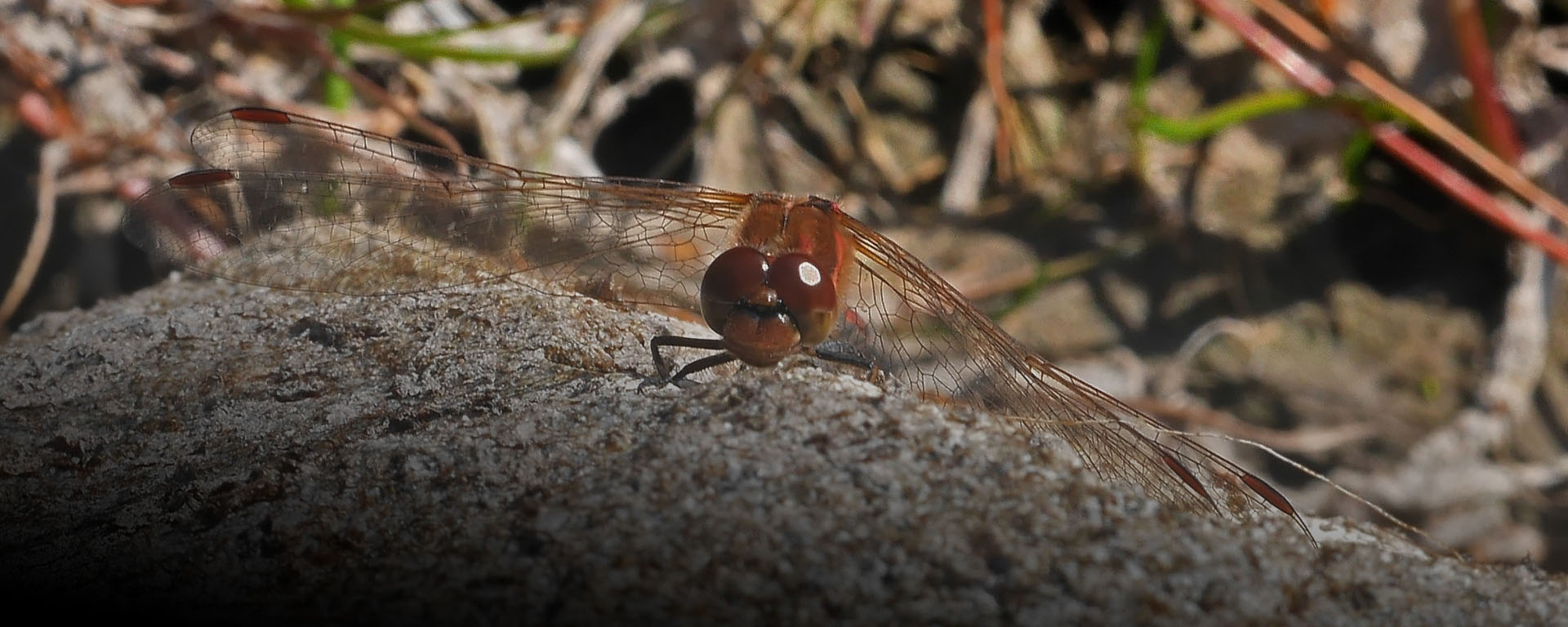
The lochan is one we visit regularly. A land bridge that appeared in the summer, cutting the waterbody into a larger and a smaller part, has slipped back underneath the rising surface. And now the common hawkers and black darters can rejoice again as they make their patrols of the water’s edge, cruising above the lush carpet of marsh pennywort and resting on the sun-warmed rocks.

A wide stony path cuts through the Scots pine trees along the lochan’s northern edge, and every few minutes we hear the sounds of passing walkers or mountain bikers. Only occasionally, though, does an individual or group make the short detour to pause and look out across the hypnotic inky ripples of the water or to marvel at the dragonflies of the near shore.
This comes as little surprise. For most visitors to the woods, the primary aspiration is movement rather than motionlessness. And, certainly, few suffer from the irresistible pull towards smaller life-forms that I do. Thus, we sit in this tranquil setting, my wife and I, warming ourselves in the September sun, breathing in the honeyed scents from the thick growth of ling beneath the surrounding pines, and watching the spectacle of these four-winged aerobats.
On my boulder, I think about the disconnect between humans and that most speciose class among our fellow animals, the insects. Yes, I understand why we might prefer to hug a far more distantly related organism like a tree than, say, a crane fly. For one thing, only the former in that pair can withstand our compacting force. But how can so many of us pass our days with a seeming obliviousness to the six-legged multitudes—an imperviousness that may briefly be punctured by nuisances, like a common wasp’s relentless investigation of the jam sandwich in our hand, but never by awe or splendour?
I know that, in some ways, my incomprehension is like that of someone with a passion for crochet, or croquet, or anything else, who cannot fathom why there are not more people who engage in their particular kind of soul nourishment. And all of us—the needleworker, the mallet swinger, and I—might be appeased with that compact adage: Each to their own. But with due respect to the practitioners of the aforementioned pastimes, and also to the proponents of that aphorism, I will say this: If you took away handicrafts from the Earth and pulled out all those square-cornered hoops from her soil, Mother Nature’s ecosystems would not collapse. Ecospheric life would not be switched in an instant from a glorious web of harmonious interactions to a lethal inward spiral.
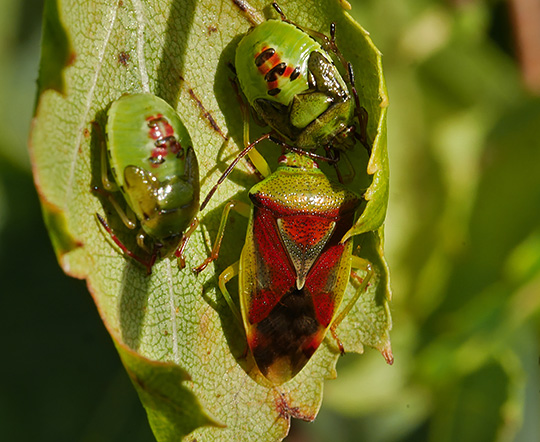
Happily, I get the chance from time to time to see if I cannot turn a few people’s minds a little more in the direction of our chitin-skinned cousins. On natural history courses that I have run, which have typically focused on shieldbugs and other Hemipterans (to use the language of the taxonomist), I am often asked something along the following lines: What benefits do they offer? What purpose do they serve? Why should we conserve them?
In answering such questions, there seems to be a pressure within modern conservation circles to talk first and foremost in economic terms. But such reasoning, being crude, beauty-stripping, and entirely focused on humans, is unsatisfactory—unless, of course, the economy in question is, say, the nutritional requirements of an insectivore. Even the latter approach risks objectifying the insects concerned by deflecting the question of value to new subjects. A mammal conservationist recently told me, in an extrapolation of that ecological line of thought for another kind of insect, that without bees there can be no tigers. Perhaps that’s true, I thought to myself, but without them there can also be no bees.
Another possible means of answering questions of benefits, purpose, and conservation—and one that I have heard being used, where insects are concerned, on a number of occasions—lies in the ‘rivet-popper’ option. Paul and Anne Ehrlich, in the 1981 book Extinction: The Causes and Consequences of the Disappearance of Species, drew what has become a much-cited analogy between the seeming redundancy of species in ecosystems and the parallel case of rivets in an aeroplane’s wing. We cannot be certain, goes their argument, about the species on whose existence any ecosystem’s integrity might hang, especially with changing stresses over time, and so driving any populations or species to extinction is something that, like popping rivets from a wing, we do at our own peril.
The analogy undoubtedly offers a useful ecological insight. And for those whose instincts take them towards shallow economic arguments, it might seem like an attractive alternative when being asked to explain the worth of species for which the financial sums have not been performed. Once again, however, it deflects the question of value away from insects; and, more problematically (at least from my perspective), it leads us towards anthropocentric territory, with its foregrounding of ‘ecosystem services’ as a motivation for conservation.
Now, in case the concerns that I express above leave any doubt about my views, I want to be clear that the importance of insects for other life-forms and broader ecosystems should not be underestimated. The elimination of insects would cause the web of life to implode; the lethal inward spiral to which I refer above is in no way a poetic exaggeration. Nonetheless, it seems to me—and this is something I feel very strongly about—that the best answers to questions about the importance of insects are those that recognize the value of them in their own right.
The participants in courses that I run are therefore offered, in response to questions of worth, some variation on that pithiest of non-economic arguments for species preservation, which was penned by David Ehrenfeld in a 1976 paper published by American Scientist: “they should be conserved because they exist and have existed for a long time.” In other, more numerous, words: they need not offer us benefits (although they probably do), their purpose is to exist (preferably in the long term), and this is grounds enough for their conservation.
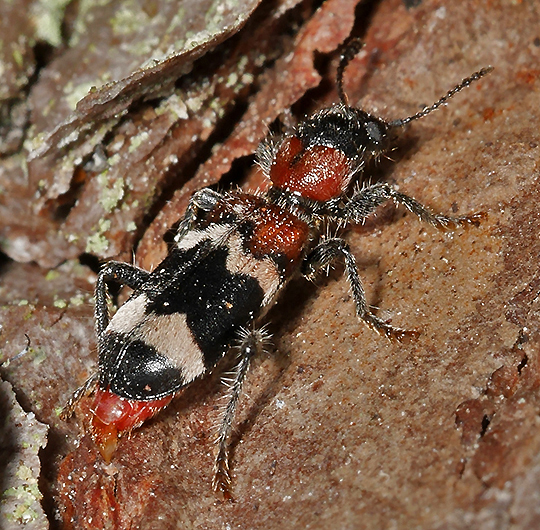
I know no better way of grasping the wisdom in Ehrenfeld’s statement, as it pertains to insects, than spending time in their presence. For when you have the privilege of quietly observing these cold-blooded miracles going about their lives—when you watch them exist—the need to find any other justification for their being starts to ebb away.
As you watch and listen, it is also quite possible that you find your nascent entomological interest gradually metamorphosing into affection—a sentiment that you might choose to describe as love. I myself do. Despite this, though, I resist citing this strong affinity that humans can feel as a primary valorization of insects’ existence. Theirs is a higher purpose than being merely there for us.
And so back to the conversation between my wife and me, about the otter and the crested tit and the trio of red squirrels we have just seen on the Rothiemurchus Estate. Our whispered exchange is unfolding not amid the landscape of pines, cowberry, and ling, but inside the Estate’s gift shop, by a rack of postcards. In addition to the mammals and birds already mentioned, the roster of photographed life also includes a roe deer, a pine marten, a capercaillie, and a wildcat. The shots are crisp, well-composed, taken locally, and printed without distracting text or ornaments. This is about as good a selection of postcards as you could expect to see.
Nevertheless, being a hard man to please in this domain, I am about to indulge in some quiet sarcasm. “One… two… no three red squirrels,” I say under my breath. “And what a surprise: not a single insect.” (“Nor any flowers,” the botanist could add, “or any fungi,” the mycologist might chime in, and so on.) My wife does not seem to be quite as troubled by the selectivity in the range of images as I am, though, and she strolls away from the threat of a monologue and into the next room, where she can browse the collection of home-made preserves on sale. I am thus left alone for further musing on the disconnect between humans and insects, using the rack of postcards in front of me as a proxy for the wildlife most likely to interest visitors to the area.
It is a few days after our trip to the Rothiemurchus Estate, and we are at a local outdoor crafts market. Walking past the stall fronts, I fix on a display of wildlife art. “Capercaillies, red squirrels, crested tits,” my list begins. “And I guess the lady behind the table is probably the artist. We should go and talk to her.”
I am quite sure, at this point, that my wife would rather head to the neighbouring stall selling fruit jams and avoid the risk of being party to an awkward conversation. “There’s even a token butterfly,” I add, with my emphasis on the t-word only serving to heighten her concern. Yet, she humours me. We walk over to the display and begin by learning that the vendor is indeed the creator. As she talks about her background and inspirations, my eyes dart around the items on the stall, and I find unexpected life-forms: a green dock beetle here; a scabious mining bee there; and an exquisite watercolour of a pine hoverfly down in front of me. Jackie Hichens is a fellow sufferer of bug-love.
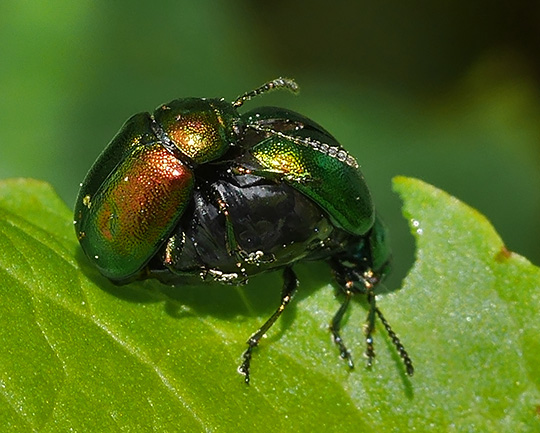
I buy a pack of five greetings cards that includes a reproduction of the pine hoverfly painting. This rare insect is found in the local area but nowhere else in the country. Most residents and visitors will never see one. The wings of the adult barely reach a third of an inch in length. The off-white larvae, from which they develop, are known as rat-tailed maggots. These mature in pine stumps, feeding on the soupy matter found within rot holes. Yet, despite all these hindrances to affection from the general public, this hoverfly—in the same vein as the spotted owl of North American old-growth forest—is gradually becoming an emblem for the recovering pine woods. The plight of the species is even attracting attention in the national press and south of Hadrian’s Wall.
Is this evidence that the disconnect I have bemoaned above is being slowly repaired? I, for one, dearly and desperately hope so.
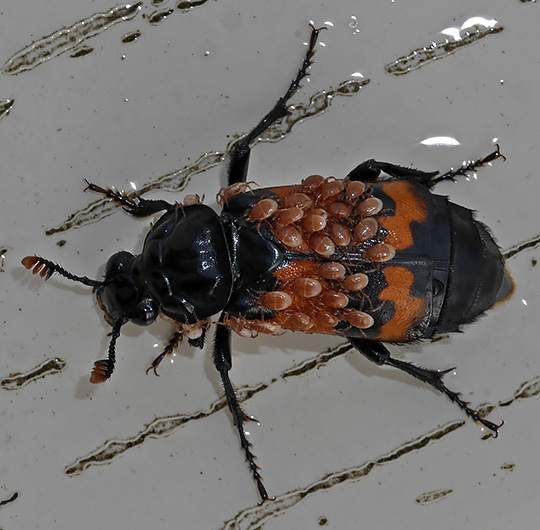
It is now a few days on the other side of the crafts market, and I receive a visitor (or, more accurately, a group of visitors). There was no knock, or any other audible announcement of the arrival, and so it is not until I open the front door that I discover the presence of company. Looking down at the surface in front of the doorway, I see a large black beetle with ruddy-orange zigzag stripes across their wing cases.
I am not aware of previously encountering a member of this species—an organism known as Nicrophorus investigator, whose adults and larvae feed on the carcasses of small animals. In what is one of those moments when the universe gives you a firm jolt, the temporal proximity of the market and this visit thus strikes me as remarkable. This is because the insect looks just like one decorating another of the greetings cards in the set I bought. The only major difference is that the guest’s orange markings are partially obscured.
Before I finish this story, I will ask you to consider a couple of questions that will require you, quite probably, to think outside the sphere of your experience. The first is as follows. If your offspring depended for nutrition on the carcasses of small animals—these being erratic but much sought-after bounties—what strategy might you employ to limit the number of other organisms claiming a share of the food source? Please take a moment to form your answer before reading on.
Nicrophorus investigator—the species with a representative at my door and a depiction on that recently purchased greetings card—belongs to a group of insects known as the sexton beetles. As reflected in this name, their most conspicuous solution to the challenge of competition is the burying of their food. To do this, pairs or small groups of beetles excavate the ground underneath the carrion. Eggs are laid in the vicinity, and the larvae, on hatching, thus have a readily available cache of nourishment. The immature beetles feed directly on the decaying meat and may also receive regurgitated fluid from their parents. Additional behaviours that work to reduce competition include the destruction of fly eggs and larvae, the removal of fungi, and the secretion of preservatives. (If your answer included any of those options then give yourself a point.)
This burying of dead animals early in the process of putrefaction, although rarely heralded, is one of the many kindnesses that insects offer us. To reinforce an earlier point, though, this is not why they do it. Rather, the purpose is the continuation of their kind.
For the second question, I want you to imagine that you and your kin draw sustenance from carrion and the associated community of living beings, such as fly larvae. However, you are small, and you lack the aid of wings, those appendages that are so useful in the race to reach newly dead creatures. How do you make yourself competitive? Again, please take a short while to reach an answer before continuing.
Various mites in the genus Poecilochirus are adapted to the ecological niche described in the second question. Employing a kind of behaviour that has been given the technical label of phoresy, these tiny invertebrates hitchhike on the bodies of sexton beetles and thus gain themselves a speedy transfer to newly dead carrion. (If you envisaged clinging to the exoskeleton of a sexton beetle in your answer, then claim a point.)
With that answer given, all that it remains for me to do is finish the tale that I had interrupted to pose the pair of questions. (The prize for anyone achieving the maximum tally of two can only, I am afraid to say, be paid in personal satisfaction).
In the story, where I left it, I am wondering about the partial obscurement of the visiting sexton beetle’s orange markings. On closer examination, the obscurement turns out to be a huddle of phoretic mites—at least twenty-nine of them by my count. As is the case, I believe, for most people who witness this ecological phenomenon, my natural instinct is sympathy for the carrier. Well, sympathy quickly turning into curiosity. I do some digging of my own and unearth details of a complicated relationship between the beetles and the mites. Since the latter can feed on the eggs of flies, who compete with the beetles, they render a service. But since they can also feed on carrion, as well as the immature life-stages of the beetles, they are, at the same time, a potential hindrance. And that is only a part of it.
For anyone interested in learning more about this extraordinary relationship, I direct you to an interesting blog post, while for anyone looking for new postcard ideas, I offer the image below.
Share your thoughts with the author
This message will be emailed to the author (and will not be published).


Read ‘Love, existence, and the nature of picture postcards’, by Joe Gray, on the #EarthTongues blog
Tweet
 Earth Tongues